Tamoxifen and SSRIs: What You Need to Know About Drug Interactions and Breast Cancer Risk
 Jan, 10 2026
Tamoxifen-SSRI Interaction Tool
Your SSRI Selection Guide
This tool helps you understand how different antidepressants interact with tamoxifen based on CYP2D6 enzyme inhibition. Select your current SSRI to see:
Your Results
When you’re taking tamoxifen for estrogen receptor-positive breast cancer, your body doesn’t just use the pill as-is. It turns it into something far more powerful: endoxifen. This active metabolite is what actually blocks estrogen from fueling cancer cells. But if you’re also taking an SSRI for depression - and many are - you might be quietly blocking that transformation. The question isn’t whether the interaction exists. It’s whether it matters.
How Tamoxifen Actually Works
Tamoxifen isn’t the star of the show - endoxifen is. The liver converts tamoxifen into endoxifen using an enzyme called CYP2D6. Without this step, tamoxifen’s anti-cancer effect drops dramatically. Studies show endoxifen is 30 to 100 times stronger at blocking estrogen than tamoxifen itself. If endoxifen levels fall below 5.97 ng/mL, some research links that to higher recurrence risk. But here’s the catch: not everyone’s liver makes endoxifen the same way.
Some people are born with weak CYP2D6 activity - about 7-10% of Europeans. Others take drugs that shut down the enzyme. SSRIs are the most common culprits. But not all SSRIs are equal. Paroxetine and fluoxetine are strong CYP2D6 blockers. Citalopram and escitalopram? Barely touch it. Venlafaxine, though technically an SNRI, is also a safe bet.
SSRIs and the CYP2D6 Power Play
Think of CYP2D6 like a factory line. Tamoxifen is the raw material. Endoxifen is the finished product. Now imagine someone walks in and jams the machine. Paroxetine? That’s a sledgehammer. It cuts endoxifen production by 60% or more. Fluoxetine is almost as bad. Sertraline? Moderate damage. But citalopram and escitalopram? They’re like someone walking past the factory without even glancing at it.
Here’s the real-world breakdown:
- Strong inhibitors: Paroxetine (Paxil), fluoxetine (Prozac) - endoxifen drops 50-65%
- Moderate inhibitors: Sertraline (Zoloft), duloxetine - endoxifen drops 20-30%
- Weak inhibitors: Citalopram (Celexa), escitalopram (Lexapro), venlafaxine (Effexor) - endoxifen drops less than 15%
That’s why oncologists now routinely ask: Which SSRI are you on? Not just whether you’re on one. The difference between paroxetine and escitalopram isn’t just a brand name - it’s the difference between a potential treatment failure and a clean safety profile.
The Clinical Evidence: Does It Actually Change Outcomes?
This is where things get messy. Lab studies scream danger. Blood tests show endoxifen levels crashing. But real patients? They don’t always follow the script.
In 2009, a Canadian study of 2,430 women found those taking paroxetine with tamoxifen had a 24% higher risk of dying from breast cancer. The risk jumped to 90% if they took both for more than six months. It was alarming. Paroxetine prescriptions dropped overnight.
Then came the big studies.
A 2016 analysis of over 16,000 women in the Kaiser Permanente database found no increased risk of recurrence - even with paroxetine. Another study of 16,000 Danish women showed the same. A 2023 Bayesian model of nearly 4,500 patients found a tiny bump in recurrence risk with CYP2D6 inhibitors - but only 14% higher, and not enough to change survival rates.
Why the disconnect? Because biology isn’t a test tube. Your body has backups. CYP3A4 and CYP2C9 can pick up some of the slack. Your liver might be working overtime. Your tamoxifen dose might be high enough to compensate. Or maybe endoxifen levels aren’t the whole story - tumor biology, genetics, and lifestyle play bigger roles than we thought.
What the Guidelines Say Now
In 2022, the American Society of Clinical Oncology (ASCO) dropped its previous warning. Their new guideline is blunt: Don’t avoid antidepressants because of tamoxifen.
They say this because depression kills. Untreated depression leads to missed appointments, poor medication adherence, and worse outcomes than any drug interaction ever could. If you’re struggling, you need help - not guilt.
But they don’t say ignore the science. They say: Choose wisely.
Here’s what most oncology teams follow now:
- Screen for depression using the PHQ-9. If score is 10+, treat it.
- Don’t start paroxetine or fluoxetine if you’re on tamoxifen.
- Use escitalopram, citalopram, or venlafaxine instead.
- If you’re already on paroxetine and doing well? Don’t panic. Talk to your doctor before switching.
The NCCN Guidelines are even clearer: avoid paroxetine and fluoxetine. Period. But they don’t say avoid all SSRIs.
What Patients Are Actually Doing
Real-world data tells a story of change. In 2010, paroxetine was prescribed to 18% of women on tamoxifen. By 2022, that number fell to 7%. Citalopram use jumped from 18% to 35%. Sertraline rose too. Oncologists aren’t ignoring the science - they’re adapting it.
Reddit threads are full of anxiety. “Should I quit my antidepressant?” “Is my cancer coming back because of Lexapro?” But the data says: if you’re on escitalopram, you’re fine. If you’re on paroxetine and feeling okay, you’re probably fine too. The risk is small. The benefit of treating depression? Huge.
One nurse practitioner in Ohio told me: “I’ve had patients cry because they thought they had to choose between mental health and survival. I tell them: you don’t. We just need to pick the right tool.”
What You Should Do Right Now
If you’re on tamoxifen and taking an SSRI:
- Check your medication. Is it paroxetine or fluoxetine? If yes, talk to your doctor - don’t stop cold turkey.
- Don’t panic if you’ve been on it for months. The risk is low, and stopping abruptly can trigger withdrawal or depression relapse.
- Ask for alternatives. Escitalopram, citalopram, or venlafaxine are safer bets.
- Don’t skip antidepressants because you’re scared. Depression lowers survival rates more than most drug interactions.
- Forget CYP2D6 testing. ASCO, FDA, and most experts agree: it doesn’t help predict outcomes. It adds cost and confusion.
The bottom line: your mental health matters as much as your cancer. You don’t have to choose. You just need the right combination.
What’s Next? The Final Answer Is Coming
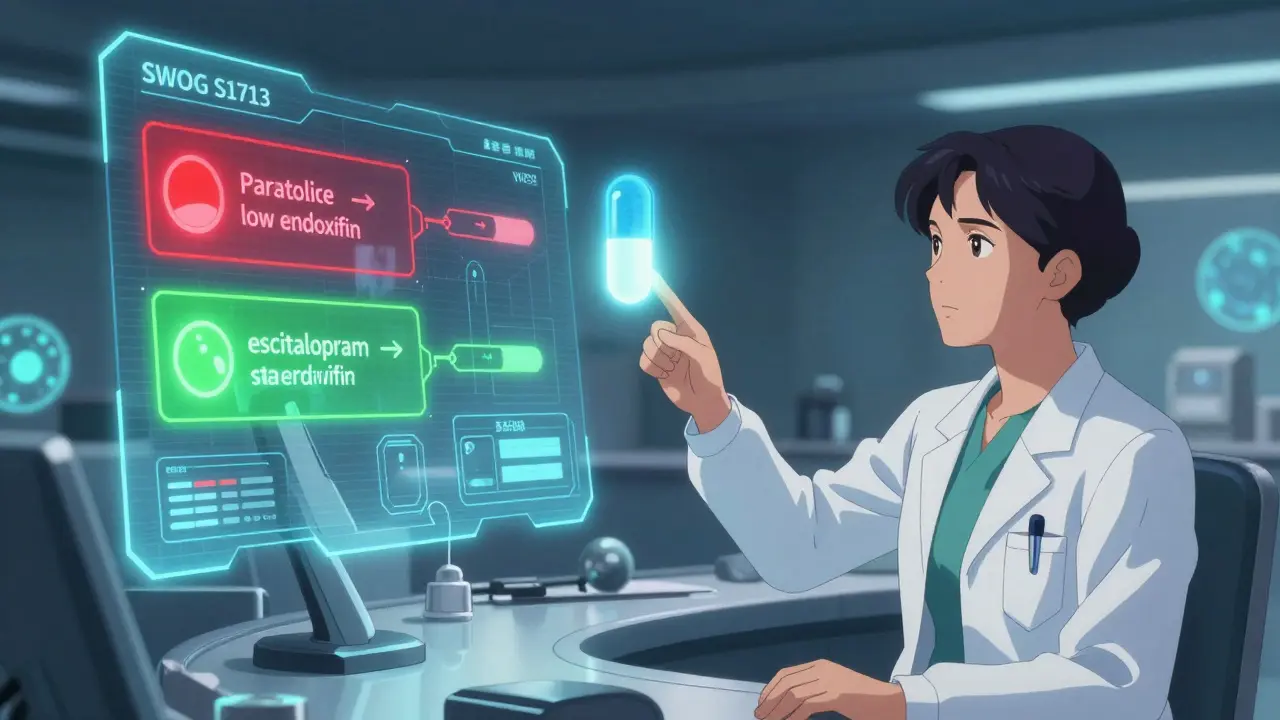
The SWOG S1713 trial, which started in 2019, is finally wrapping up in 2025. It’s the first study to randomly assign women on tamoxifen to either paroxetine or a placebo - while measuring endoxifen levels in real time. If endoxifen drops and recurrence rises, we’ll know for sure. If not, this whole debate may finally be put to rest.
Some experts think we’ll look back on this as a classic case of overinterpreting lab data. Like the old belief that TPMT testing was needed for 5-FU chemotherapy - it wasn’t. The body adapts. Biology is messy. And sometimes, the most powerful drug isn’t the one in the pill - it’s the one that lets you sleep, eat, and keep fighting.
Christina Widodo
January 11, 2026 AT 08:09So if I'm on escitalopram and my oncologist says I'm fine, but my aunt on paroxetine just had a recurrence, should I still be worried? I mean, I get the science but my gut says otherwise.
Jessica Bnouzalim
January 11, 2026 AT 15:06I was on paroxetine for 3 years with tamoxifen and still in remission. My doctor said the studies are messy and my liver must be a beast. I’m not switching unless I have to. Mental health > theoretical risk. 🙌
Sona Chandra
January 13, 2026 AT 01:02OMG I JUST REALIZED I’M ON PAROXETINE AND I’VE BEEN TAKING TAMOXIFEN FOR 2 YEARS. IS MY CANCER COMING BACK RIGHT NOW?? I’M GOING TO SCREAM. I NEED A NEW DRUG NOW. I’M DYING. I’M DYING.
Katherine Carlock
January 14, 2026 AT 03:17My therapist switched me from sertraline to escitalopram last year because of this exact issue. Honestly? I felt better. Not just because of the drug change - but because I finally felt like my care team was listening. No one ever asked me which SSRI I was on until then.
Jennifer Phelps
January 15, 2026 AT 19:14So if CYP2D6 testing doesn’t matter why do labs still offer it I’m confused
Prachi Chauhan
January 16, 2026 AT 16:29It’s funny how we treat biology like a switchboard when it’s more like a jungle. One path gets blocked, another grows around it. Endoxifen levels drop but the body adapts. Maybe the real danger isn’t the drug interaction - it’s our need to reduce everything to a number. We forget we’re not machines. We’re living, breathing, grieving, healing organisms. Depression doesn’t care about enzyme kinetics. It just wants you to stop fighting.
Lauren Warner
January 16, 2026 AT 18:40Let’s be real - the 2016 Kaiser study had funding from pharma. The Danish one excluded patients with comorbidities. The real data is buried in retrospective analyses with selection bias. If you’re on paroxetine and your endoxifen is below 5 ng/mL, you’re at risk. Period. Don’t let guidelines sugarcoat what the lab results show.
Lelia Battle
January 17, 2026 AT 15:35Thank you for writing this. I’ve been terrified to speak up about my depression because I thought I was choosing cancer over mental health. I’m on escitalopram now. I cried the day my oncologist said, ‘You don’t have to choose.’ That moment saved me more than any pill ever could.
Jessica Bnouzalim
January 18, 2026 AT 08:10Lauren, I get your skepticism - but if we start treating every conflicting study as a conspiracy, we’ll never trust anything. My oncologist didn’t dismiss the science - she just weighed it against my quality of life. I’m alive. I’m functional. I’m not in a clinical trial. I’m just a person trying to survive.
Craig Wright
January 19, 2026 AT 00:56As a British oncologist, I find this entire debate fascinating. In the NHS, we rarely even test CYP2D6. We prescribe escitalopram as default. If a patient is stable on paroxetine, we do not switch. The cost of disruption outweighs the unproven risk. Evidence-based medicine must also be cost-effective and patient-centered. This is not America.