Medication Guide Distribution Requirements for Pharmacists and Providers
 Mar, 4 2026
Medication Guide Distribution Calculator
Distribution Decision
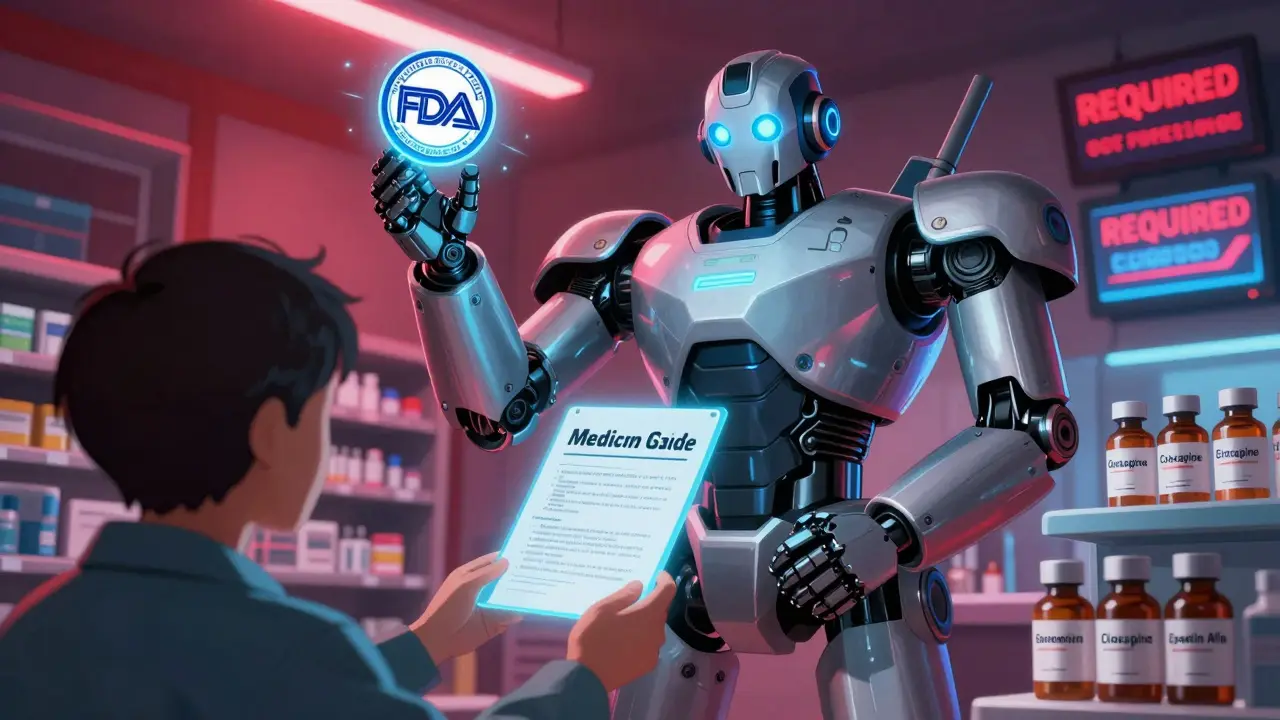
When you pick up a prescription, you might not think about the small paper handout that comes with it. But for certain drugs, that guide isn’t just a suggestion-it’s the law. The FDA requires Medication Guides to be handed out to patients for over 200 high-risk medications. These aren’t generic brochures. They’re official, FDA-approved documents designed to warn patients about serious side effects, clarify when to take the drug, and explain why skipping doses could be dangerous. For pharmacists and providers, knowing exactly when and how to distribute these guides isn’t optional. Get it wrong, and you risk patient safety and regulatory penalties.
When Is a Medication Guide Required?
The FDA doesn’t require Medication Guides for every prescription. Only drugs that meet one of three specific criteria get them: when patient education could prevent life-threatening reactions, when the risks outweigh the benefits in a way that affects a patient’s decision to use the drug, or when taking the drug exactly as directed is critical to its effectiveness. Common examples include isotretinoin (Accutane) for acne, clozapine (Clozaril) for schizophrenia, and estrogen-based therapies. Each of these carries risks like birth defects, severe blood disorders, or blood clots.
Here’s where it gets tricky: distribution rules change depending on where the drug is given. In a community pharmacy, if you’re handing a patient a prescription for self-administration-like a 30-day supply of clozapine-you must give them the Medication Guide every single time they refill it. No exceptions. Even if they got it last month, you still hand it out again.
But in outpatient clinics, like an infusion center or dialysis unit, the rule is different. You only need to give the guide the first time the patient receives the drug. After that, unless the guide itself has been updated, you don’t have to hand it out again. This distinction trips up a lot of providers. A 2022 ASHP survey found that 68% of hospital pharmacists were unsure about when to distribute guides in clinic settings. One pharmacist on Reddit asked: "We give epoetin alfa weekly in our oncology clinic-do we need the guide every visit?" The answer? No, just the first time.
What About Hospitals and Nursing Homes?
Medication Guides are not required in inpatient settings like hospitals or nursing homes. That doesn’t mean patients aren’t informed. Staff are still required to verbally explain risks, side effects, and dosing instructions. But the paper guide? It’s not mandated. The FDA’s reasoning is simple: in these settings, healthcare providers are directly supervising administration. There’s less room for patient error, so the guide’s role shifts from mandatory handout to supplemental tool.
Electronic Delivery Is Now an Option
Back in 2020, the FDA started allowing electronic versions of Medication Guides. Today, patients can opt for a digital copy instead of paper. But here’s the catch: you still have to offer the paper version. You can’t force someone to accept an email or app notification. If a patient asks for paper, you give it. If they say, "I’d rather get it on my phone," you can send it via secure patient portal or email-but only after confirming they understand and consent.
The FDA is pushing for more electronic options. A proposed rule in May 2023 suggests expanding digital access, especially for patients who use apps to manage their meds. But for now, the law is clear: paper is the default. Digital is the alternative.

Medication Guides vs. Other Patient Info
Not all patient handouts are the same. Many pharmacies give out Consumer Medication Information (CMI) or Patient Medication Information (PMI). These are helpful, but they’re voluntary. They’re created by pharmacies or third-party vendors, not the FDA. They might cover common side effects, but they don’t have to include the same level of detail or risk warnings.
Medication Guides are different. They’re written by drug manufacturers, reviewed and approved by the FDA, and must follow a strict format. They include specific warnings, dosing instructions, and what to do in case of overdose. For example, the guide for isotretinoin doesn’t just say "avoid pregnancy." It tells patients they must enroll in the iPLEDGE program, use two forms of birth control, and get monthly pregnancy tests. That level of detail? Only Medication Guides deliver it.
Some REMS programs, like iPLEDGE, actually require the guide as part of their safety plan. That means even if the drug didn’t originally need a guide, the REMS adds the requirement. So if a provider is giving isotretinoin, they’re legally bound to distribute the guide-even if the drug’s label doesn’t list it as mandatory.
Why This Matters: Real-World Consequences
It’s easy to see Medication Guides as paperwork. But they’re one of the few FDA tools designed to directly prevent harm. A 2022 study in the Journal of Health Communication found that only 37% of patients could recall key safety points from the guide one week after receiving it. That’s a red flag. If patients don’t understand the risks, they might stop taking the drug, skip follow-ups, or ignore warning signs.
On the flip side, when guides are used correctly, they work. A 2023 study from UCSF showed that after installing a barcode system that flagged when a Medication Guide was needed, their distribution errors dropped by 73%. That’s not just efficiency-it’s safety.
But there’s also a cost. Pharmacists report spending 10-15 extra minutes per day just tracking which drugs need guides, checking for updates, and managing patient requests. A 2021 commentary in the Journal of the American Pharmacists Association questioned whether the administrative burden is worth it for drugs with low risk of misuse. The FDA is reviewing this right now. A congressionally mandated study is due in late 2024, and changes could be coming.

What Pharmacists Need to Do Today
Here’s what you need to get right:
- Know which drugs in your inventory require a Medication Guide. Update your list every time the FDA releases a new one.
- Always give the guide when dispensing to a patient for self-administration-no matter how many times they’ve received it before.
- In clinics, give the guide only on the first administration unless the guide has been revised.
- Offer paper or digital, but never force digital. Always have paper on hand.
- Train your staff. A 2022 survey showed 42% of pharmacists distributed guides unnecessarily because they weren’t sure of the rules.
- Check for updates. The FDA approves about 120 new or revised guides each year. A change in the guide means you must redistribute it-even if the patient got it last week.
Some pharmacies use digital systems that automatically flag Medication Guides when a prescription is processed. Others post printed checklists above the counter. Whatever method you use, make sure it’s consistent and auditable.
What’s Coming Next?
The number of drugs requiring Medication Guides is expected to rise. Specialty medications for cancer, rare diseases, and complex conditions are entering the market, and the FDA is more likely to require patient education for these. Evaluate Pharma predicts a 22% increase over the next five years.
The FDA is also looking at improving readability. A draft guidance from January 2023 wants guides to use clearer language, shorter sentences, and visual aids like icons. Right now, many guides are dense and hard to understand. If you’ve ever read one, you know: it’s not user-friendly.
For now, the rules stand. Pharmacists and providers are on the front lines. You’re not just filling prescriptions. You’re delivering safety.
Do I need to give a Medication Guide every time a patient refills a prescription?
Yes-if the drug requires a Medication Guide and the patient is receiving it for self-administration (like at home), you must provide the guide with every refill. This applies even if they received it last month. The FDA requires distribution each time the drug is dispensed in community pharmacy settings.
Can I give a Medication Guide electronically instead of on paper?
Yes, but only if the patient requests it or consents to digital delivery. You must still offer the paper version. Electronic delivery can be done through secure patient portals, email, or apps-but you can’t refuse to give paper if the patient asks for it. The FDA’s 2020 guidance allows this, but paper remains the default.
Are Medication Guides required in hospitals?
No. Medication Guides are not required in inpatient settings like hospitals or nursing homes. However, healthcare staff must still counsel patients on risks, dosing, and side effects. The FDA considers direct supervision in these settings sufficient to ensure safe use, so the paper guide is not mandatory.
What’s the difference between a Medication Guide and a Patient Medication Information (PMI) sheet?
Medication Guides are FDA-approved, drug-specific documents required by law for high-risk medications. PMI sheets are voluntary, non-FDA-approved summaries created by pharmacies or vendors. They’re helpful but don’t carry the same legal weight or include the same level of risk detail. Only Medication Guides are reviewed and approved by the FDA.
What happens if I forget to give a Medication Guide?
You could face regulatory scrutiny, especially if a patient suffers harm because they weren’t informed of a known risk. While the FDA doesn’t routinely penalize pharmacies for single oversights, repeated failures or incidents tied to missed guides can lead to audits, warnings, or loss of licensure. More importantly, you’re putting patients at risk. Always have a system in place to ensure compliance.
How often are Medication Guides updated?
The FDA reviews about 120 Medication Guide submissions each year. Updates happen when new safety data emerges-like a newly discovered side effect or change in dosing guidelines. When a guide is updated, you must distribute the new version the first time the drug is dispensed after the change. Even if the patient got the old version last week, you must give them the new one.
Do REMS programs affect Medication Guide distribution?
Yes. Some Risk Evaluation and Mitigation Strategy (REMS) programs, like iPLEDGE for isotretinoin, require Medication Guides as part of their safety plan. In these cases, distribution is mandatory-even if the drug wouldn’t normally require one. Always check if the drug is part of a REMS program, as this overrides standard distribution rules.
Final Takeaway
Medication Guides aren’t just paperwork. They’re a safety net. For drugs with serious risks, they’re often the last line of defense between a patient and a preventable injury. Pharmacists and providers who understand the rules don’t just follow regulations-they protect lives. Stay updated. Train your team. And never assume a patient already knows the risks. If you’re unsure whether a guide is needed, give it. Better safe than sorry.
Tim Hnatko
March 4, 2026 AT 16:38Amina Aminkhuslen
March 6, 2026 AT 03:35amber carrillo
March 6, 2026 AT 08:56Aaron Pace
March 7, 2026 AT 12:56Ferdinand Aton
March 8, 2026 AT 07:52Joey Pearson
March 9, 2026 AT 15:56William Minks
March 10, 2026 AT 22:42Jeff Mirisola
March 11, 2026 AT 13:12Susan Purney Mark
March 12, 2026 AT 11:24Roland Silber
March 14, 2026 AT 11:22Patrick Jackson
March 16, 2026 AT 04:15Ian Kiplagat
March 17, 2026 AT 18:07