Perception vs Reality: Why Generics Seem Less Effective Than Brand-Name Drugs
 Jan, 26 2026
Have you ever been handed a generic pill and thought, “This can’t be the same”? You’re not alone. Millions of people in the U.S. switch from brand-name drugs to generics every year-often because their insurance requires it or they want to save money. But then something strange happens: they start feeling worse. Their headaches don’t go away. Their blood pressure creeps up. Their anxiety spikes. They blame the generic. And they stop taking it.
Here’s the truth: generic drugs are not less effective. They’re not weaker. They’re not made with cheaper ingredients that somehow lost their power. By law, they must contain the exact same active ingredient, in the exact same strength, delivered the exact same way as the brand-name version. The U.S. Food and Drug Administration (FDA) requires them to be bioequivalent-meaning they get into your bloodstream at the same rate and amount as the brand-name drug, within a scientifically accepted range of 80% to 125%. That’s not a loophole. That’s a proven standard, tested on healthy volunteers in clinical studies. If a generic didn’t meet this, it wouldn’t be sold.
So why do so many people feel like generics don’t work?
The Nocebo Effect: When Your Mind Makes You Sick
There’s a powerful force at play here called the nocebo effect. It’s the opposite of the placebo effect. Instead of expecting relief and feeling better, you expect trouble-and your body responds accordingly. A 2023 study in JAMA Network Open showed this clearly: patients told that generics were “just as good” had 34% better adherence. Those told they were “less effective” had 41% worse adherence. The drug didn’t change. The patient’s belief did.
Think about it. You’ve been on a brand-name medication for years. You know how it feels when it works. Then your pharmacist hands you a pill that looks different-smaller, maybe a different color, with a strange logo. You’re told, “It’s the same thing.” But your brain doesn’t believe it. Your body starts scanning for signs of failure. That slight dizziness you used to ignore? Now it’s the generic making you sick. That little spike in heart rate? Must be the cheap version. The truth? It’s probably stress, anxiety, or just your body adjusting to a new pill shape.
Why the Stigma Persists
Generics have been around since the 1980s, thanks to the Hatch-Waxman Act. But the stigma didn’t vanish with the patents. It grew. Partly because of how they’re marketed. Brand-name companies spend billions every year on ads that make their drugs look like science miracles-bright colors, smiling families, dramatic voiceovers. Generics? They’re sold in plain packaging, with no ads at all. That silence speaks volumes. It makes people wonder: If it’s so good, why don’t they advertise it?
Then there’s the cost. Generics cost 80-85% less than brand-name drugs. That’s a good thing-$1.7 trillion saved in the U.S. since 2009. But in some communities, especially rural areas and among lower-income groups, low price gets twisted into low quality. In Alabama’s Black Belt region, patients have told researchers they believe generics are “for poor people,” “not real medicine,” or “need higher doses.” These aren’t facts. They’re myths. But they’re powerful ones.
Even doctors aren’t immune. A 2020 survey found that 11% of physicians believe generics are less effective, and 27% think they cause more side effects. That’s not science. That’s perception. And when your doctor hesitates, you hesitate too.
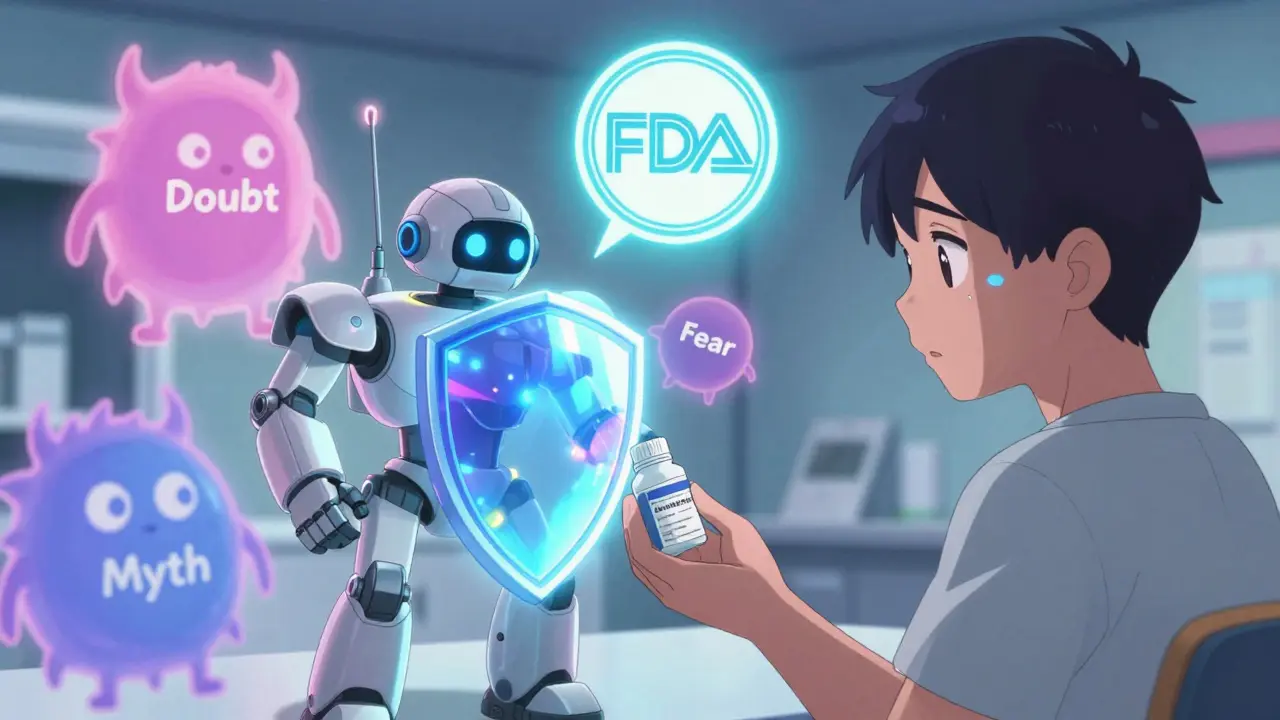
Demographics and the Trust Gap
Not everyone doubts generics equally. A 2015 study in the Journal of General Internal Medicine found that non-Caucasian patients were significantly more skeptical than white patients-43% vs. 29% believed generics weren’t clinically equivalent. They were also more likely to ask for brand-name drugs, even when it cost more. Why? Historical distrust in the medical system plays a role. Past abuses, unequal care, and misinformation have left deep scars. When a new drug comes in that looks unfamiliar and costs less, it’s easy to assume it’s being pushed because it’s “less important.”
And then there’s the packaging. A 2022 analysis found that 17% of online pharmacy reviews mentioned concerns about generics. Comments like “My anxiety got worse after switching to generic sertraline” are common. But when researchers dug into the data, they found no difference in outcomes between brand and generic sertraline. The only variable? Expectation.
When Generics Really Do Cause Problems (And When They Don’t)
There are rare exceptions. Some drugs have a narrow therapeutic index-meaning the difference between a safe dose and a toxic one is tiny. Think warfarin, levothyroxine, or certain epilepsy meds. Even here, the FDA has extra rules. And studies show that even for these drugs, generics perform just as well as brands when properly monitored.
A 2017 Canadian study did find a spike in side effects after switching to generic blood pressure meds. But the researchers admitted it might not be the drug-it could be that patients switching were sicker, had worse access to care, or were already struggling with adherence. Correlation isn’t causation. And multiple large-scale studies since then have confirmed: for the vast majority of drugs, generics are just as safe and effective.

What Actually Works: How to Build Trust
So how do you fix this? It’s not about more ads. It’s about better conversations.
A 2022 meta-analysis found three things that work:
- Show the active ingredient. “This generic has the same active ingredient as your old pill: sertraline. Same molecule. Same effect.” This boosted patient acceptance by 87%.
- Hand them FDA paperwork. A simple printout from the FDA’s website saying “Generics are approved as safe and effective” increased trust by 76%.
- Address the nocebo effect directly. “Some people feel different when they switch pills-not because the medicine changed, but because their brain is used to the old one. That’s normal. It usually passes in a few days.” This cut concerns by 68%.
Yet most providers don’t do this. The average doctor spends just 3.2 minutes per prescription addressing patient concerns about generics. In low-income clinics, that number rises to 15% of total consultation time. That’s a lot of time spent reassuring people that a pill they’ve been handed is real medicine.
The Bigger Picture: Why This Matters
This isn’t just about pills. It’s about health equity. When people stop taking their meds because they think the generic doesn’t work, they end up in the ER. They get sicker. They cost the system more. A 2019 study found that 22% of patients who believed generics were inferior stopped taking them altogether. Only 8% of those who didn’t doubt them did. That’s a 2.75x higher rate of non-adherence.
The FDA estimates that eliminating perception gaps could save $5.9 billion a year in the U.S. alone. Brand-name companies spend $1.8 billion a year on marketing that subtly undermines generics-without ever breaking the law. Meanwhile, the FDA’s public education campaign, “It’s the Same Medicine,” reached 27 million people but only 19% remembered it. That’s not a failure of information. It’s a failure of connection.
The solution isn’t more data. It’s more empathy. It’s pharmacists taking 30 extra seconds to say, “I know this looks different, but it’s the same medicine your body’s used to. I’ve seen hundreds of people switch without a problem.” It’s doctors writing on the prescription: “This is not a substitute. It’s the same drug.”
Generics aren’t a compromise. They’re a triumph of science. They’re how we make life-saving medicine affordable. And they work-just as well as the brand names. The only thing holding them back is what we believe.
Next time you’re handed a generic, look at the active ingredient. Check the FDA website. Talk to your pharmacist. You might find out the real problem wasn’t the pill.
It was the story you told yourself about it.
Marian Gilan
January 28, 2026 AT 00:27lol so the FDA is just lying to us now? 🤔 maybe the generic has nano-chips that make you depressed on purpose. i heard the gov uses these pills to control the sheeple. my cousin took a generic omeprazole and his dreams turned black. he now talks to his toaster. it's not the nocebo effect... it's the *agenda*.
Conor Murphy
January 28, 2026 AT 05:09Man, this hit home. I switched from brand-name Lexapro to generic escitalopram after my insurance flipped out. Felt weird at first - like my brain was underwater. But I stuck with it, talked to my pharmacist, and after two weeks? I was back to normal. Honestly? The pill didn't change. My fear did. 🤝
Conor Flannelly
January 28, 2026 AT 12:27It's fascinating how deeply our biology is intertwined with our psychology. The nocebo effect isn't just 'thinking too much' - it's your autonomic nervous system literally reacting to narrative. Your body doesn't distinguish between a story and a chemical signal. If you believe the pill is weak, your cortisol spikes, your gut tightens, your sleep frays. The generic hasn't changed. Your belief system has. And that’s why education needs to be emotional, not just factual. Show the molecule. Hold the bottle. Say: 'This is the same thing your body already trusts.' That’s the real prescription.
Patrick Merrell
January 29, 2026 AT 09:40Typical liberal propaganda. If you’re poor enough to need generics, you’re probably too lazy to take your meds right anyway. Stop whining and get your life together. Also, why are you even on antidepressants? Just go to church. Or do push-ups. Or both. 🤬
bella nash
January 29, 2026 AT 16:48One must acknowledge the epistemological dissonance inherent in the patient-provider dynamic vis-à-vis pharmaceutical perception. The ontological status of the generic drug is unambiguous under regulatory frameworks. Yet the phenomenological experience of the patient remains subject to sociocultural conditioning. The divergence is not a flaw in pharmacology but a manifestation of hermeneutic misalignment.
SWAPNIL SIDAM
January 31, 2026 AT 02:29I am from India. We use generics every day. My dad takes blood pressure medicine for 10 years. Same pill. Same result. No drama. Why Americans make it so hard? Just take the pill. Life is already hard enough.
Geoff Miskinis
February 1, 2026 AT 19:36It’s amusing how the entire discourse reduces to a psychological hack while ignoring the structural realities. The pharmaceutical industry has engineered this entire narrative - brand loyalty is a $200B marketing construct. The FDA’s bioequivalence standard is a technicality. Real-world pharmacokinetics vary by formulation excipients, dissolution rates, even coating thickness. To claim ‘it’s the same’ is intellectually dishonest. The data may say 80–125%, but that’s a statistical loophole, not a biological guarantee.
Ryan W
February 2, 2026 AT 14:03Let’s be real - the FDA’s 80–125% window is a joke. That’s a 45% variance. If I’m dosed with 80% of the active ingredient, I’m getting sub-therapeutic levels. That’s not ‘equivalent’ - that’s a gamble. And don’t get me started on the Chinese API supply chain. We’re outsourcing our health to factories that don’t even have OSHA. This isn’t science. It’s American capitalism with a Band-Aid.
Henry Jenkins
February 2, 2026 AT 23:11I think Geoff and Ryan are missing the forest for the trees. Yes, there are edge cases with narrow therapeutic index drugs - but those are exceptional, not the norm. The real issue isn’t the chemistry. It’s the cultural narrative. We’ve been sold the idea that expensive = better. That’s why luxury brands charge $500 for a t-shirt. It’s the same with drugs. The fact that we’ve saved $1.7 trillion in 15 years with generics? That’s a win. But we’re still treating patients like idiots who can’t handle a pill that looks different. We need to stop talking about ‘equivalence’ and start talking about ‘trust.’ And trust is built with human conversation, not FDA brochures.
Napoleon Huere
February 3, 2026 AT 14:37Here’s the deeper truth: we don’t distrust generics because they’re cheap. We distrust them because we’ve been taught that our bodies are fragile, our health is fragile, and that only corporate-approved symbols of power - the branded pill, the fancy logo, the TV ad - can protect us. We’ve outsourced our agency to Big Pharma. The generic is a mirror. It shows us that we’ve been manipulated. And that’s scarier than any side effect. So we reject the pill. Not because it doesn’t work. But because it forces us to face how little control we really have.