Opioids with MAOIs: The Deadly Interaction You Must Avoid
 Dec, 17 2025
MAOI-Opioid Safety Checker
Check Your Medication Safety
Combining opioids with MAOIs isn’t just risky-it’s deadly. This isn’t theoretical. People have died from this mix. And it’s still happening today, even though doctors have known about it since the 1960s. If you’re taking an MAOI for depression, or someone you know is, and you’re considering an opioid for pain, stop. Read this. Your life could depend on it.
What Are MAOIs and Why Do They Matter?
MAOIs-monoamine oxidase inhibitors-are a class of antidepressants that include drugs like phenelzine (Nardil), tranylcypromine (Parnate), and isocarboxazid (Marplan). They work by blocking enzymes that break down key brain chemicals: serotonin, norepinephrine, and dopamine. This boosts mood in people with treatment-resistant depression. But that same mechanism makes them extremely dangerous when mixed with certain opioids.
Though they’ve been replaced by SSRIs and SNRIs for most patients, about 1.2% of antidepressant prescriptions in the U.S. still involve MAOIs. That’s roughly 1.2 million people in America alone who are at risk if they accidentally take the wrong painkiller. Many don’t even realize they’re on one. Some patients are told their MAOI is "just another antidepressant," and no one warns them about the hidden dangers with pain meds.
The Deadly Mix: How Opioids and MAOIs Collide
The danger comes from two things happening at once. MAOIs stop your body from breaking down serotonin. Meanwhile, some opioids-like tramadol, meperidine, and methadone-push even more serotonin into your brain. It’s like turning on a faucet while plugging the drain. Serotonin levels spike uncontrollably.
This leads to serotonin syndrome: a medical emergency. Symptoms include high fever (over 104°F), muscle rigidity, seizures, confusion, rapid heart rate, and loss of consciousness. In severe cases, it causes organ failure and death. A 2019 review found mortality rates between 2% and 12% in serious cases. And the timeline? Symptoms can hit within 30 minutes to a few hours after taking the opioid.
One case from Reddit tells the story: a patient on phenelzine took tramadol for a toothache. Within hours, their body temperature hit 107.1°F. Their muscles locked up so hard they couldn’t breathe. They had seizures. They spent three days in intensive care. This isn’t rare. The FDA’s database shows 89 deaths from MAOI-opioid interactions between 2015 and 2022.
Which Opioids Are Most Dangerous?
Not all opioids are equally risky. Some are outright banned with MAOIs. Others are a gray zone.
- Meperidine (Demerol): The worst offender. Over 37 documented deaths since the 1960s. It directly releases serotonin and blocks its reuptake. The FDA and American Psychiatric Association both say: never use with MAOIs.
- Tramadol: Often mistaken as "safe" because it’s called a "non-narcotic." But it’s a serotonin reuptake inhibitor with opioid effects. It’s linked to 68 serotonin syndrome cases between 2010-2022. Prescriptions to MAOI users rose 22% between 2015 and 2022-despite the known danger.
- Methadone: Used for pain and addiction treatment. It also inhibits serotonin reuptake and blocks NMDA receptors. Risk is moderate but real. At least 17 fatal cases reported.
- Morphine, oxycodone, hydromorphone: Lower risk, but still not safe. They can indirectly raise serotonin. Avoid unless absolutely necessary and under strict supervision.
- Buprenorphine: The only opioid with emerging evidence of relative safety. Used at low doses (0.2-0.4 mg), it’s been given to over 140 MAOI patients without serotonin syndrome in clinical studies. Still, proceed with caution.
Even reversible MAOIs like moclobemide aren’t safe with tramadol. Case reports show serotonin syndrome even with low doses. There’s no "safe" opioid for someone on an MAOI unless proven otherwise by a specialist.
How Long Should You Wait After Stopping an MAOI?
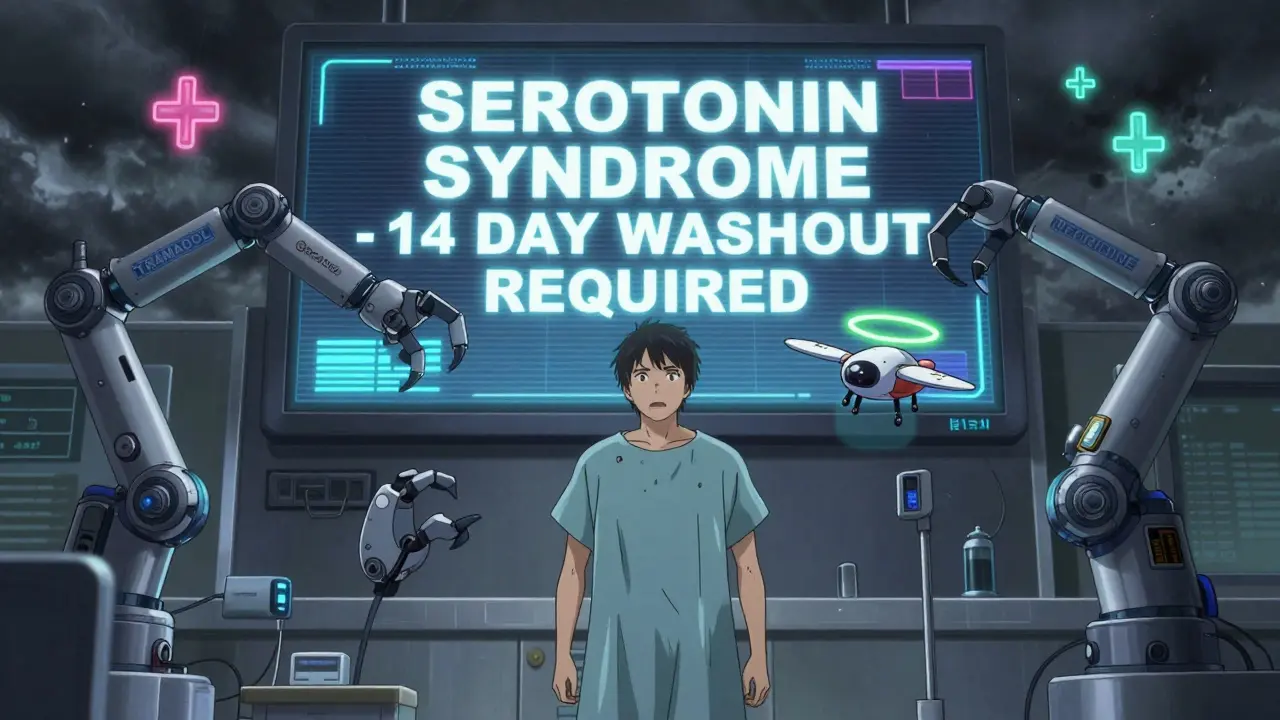
Stopping an MAOI doesn’t mean the danger is gone. These drugs permanently disable the MAO enzyme. Your body needs time to grow new enzymes. For irreversible MAOIs like Nardil or Parnate, that takes about 14 days. That’s why experts require a 14-day washout before starting any opioid with serotonergic activity.
For the transdermal selegiline patch (Emsam), the FDA confirms the same 14-day rule. Even though it’s a patch, it still blocks brain MAO-A. Reversible MAOIs like moclobemide clear faster-24 hours is usually enough-but don’t assume. Always check with your doctor.
Many patients think, "I stopped my MAOI last week, so I’m fine." They’re wrong. That’s why so many emergencies happen: people take tramadol or codeine with acetaminophen, not realizing the combo still triggers serotonin syndrome.
What Should You Use for Pain Instead?
If you’re on an MAOI and need pain relief, your options are limited-but not zero.
- Buprenorphine: As mentioned, it’s the safest opioid option. Use low doses only.
- Acetaminophen (Tylenol): Safe. No interaction. Use up to 3,000 mg per day.
- NSAIDs: Ibuprofen, naproxen, celecoxib. These are fine. Avoid if you have kidney or stomach issues.
- Non-drug options: Heat packs, physical therapy, nerve blocks, acupuncture. These can reduce reliance on pills.
Never use tapentadol (Nucynta), codeine, or hydrocodone. They’re serotonergic. Don’t trust "over-the-counter" painkillers that combine acetaminophen with tramadol-that’s still dangerous. And never, ever use meperidine. Not in hospitals. Not in clinics. Not ever.
Why Are These Mistakes Still Happening?
You’d think with decades of warnings, this wouldn’t happen. But it does.
A 2022 study in JAMA Internal Medicine found that 4.3% of MAOI users got a contraindicated opioid within 14 days of starting the antidepressant. That’s over 11,000 dangerous prescriptions a year in the U.S. alone. Why? Because primary care doctors aren’t trained in psychiatric pharmacology. Emergency rooms don’t always ask about antidepressants. Pharmacists miss it because the drug names don’t scream "danger."
One anesthesiologist shared: "I’ve seen two near-misses. One patient on Parnate got Demerol for surgery. Their blood pressure shot to 240/140. Another on Nardil took tramadol for a toothache and had full serotonin syndrome. We had to cool them down and give cyproheptadine."
Even worse: a 2022 survey found 31% of emergency physicians didn’t know tramadol was contraindicated with MAOIs. That’s not ignorance-it’s a systemic failure.
What Should You Do Right Now?
If you’re on an MAOI:
- Make a list of every medication you take-prescription, over-the-counter, supplements, even cough syrups (dextromethorphan is a major risk).
- Check that list against the FDA’s 12 contraindicated opioids. If any are on there, talk to your doctor immediately.
- Ask for a printed wallet card from NAMI or your pharmacy listing your contraindications. Carry it with you.
- If you’re scheduled for surgery or dental work, tell every provider you’re on an MAOI. Don’t assume they’ll check your chart.
- Set a 14-day reminder after stopping an MAOI before taking any new painkiller.
If you’re a caregiver or family member:
- Don’t let someone on an MAOI take pain meds without checking with their psychiatrist or pharmacist.
- Watch for signs: sudden fever, stiff muscles, confusion, fast heartbeat. If these appear, call 911. Say "serotonin syndrome." Time is critical.
What’s Being Done to Stop This?
Change is coming-but slowly.
Electronic health records now have "hard stops" that block prescriptions of meperidine or tramadol if an MAOI is active. Epic Systems blocked over 8,400 dangerous prescriptions in 2021. But 1,200 were overridden-because doctors clicked through the warning. That’s human error.
The FDA now requires updated medication guides for all MAOIs that list 12 specific opioids to avoid. The European Medicines Agency now requires mandatory training for prescribers. In 2023, the FDA approved a digital tool called SerotoninSafe that integrates with hospital systems and cuts prescribing errors by 76%.
But the real problem? Awareness. Patients don’t know. Doctors don’t know. Pharmacists don’t know. And people keep dying.
There’s no excuse. We’ve had this knowledge for 60 years. We have tools to prevent it. We just need to use them.
Can I take tramadol if I’m on an MAOI?
No. Tramadol is extremely dangerous with MAOIs. It increases serotonin levels and blocks its reuptake, which can trigger serotonin syndrome within hours. There are over 60 documented cases of serotonin syndrome from this combo, including fatal ones. Never take tramadol if you’re on phenelzine, tranylcypromine, or any other MAOI.
How long after stopping an MAOI can I take an opioid?
Wait at least 14 days after stopping an irreversible MAOI like Nardil or Parnate. The enzymes that break down serotonin need time to regenerate. Even if you feel fine, the biochemical risk remains. For reversible MAOIs like moclobemide, 24 hours may be enough-but only under medical supervision. Never guess. Always confirm with your prescriber.
Is buprenorphine safe with MAOIs?
Yes, at low doses (0.2-0.4 mg sublingual), buprenorphine appears safe for acute pain in MAOI users. Studies show no serotonin syndrome cases in over 140 administrations. It’s the only opioid currently recommended for this group. But it still carries respiratory depression risk, so use only under medical guidance.
What painkillers are safe with MAOIs?
Acetaminophen (Tylenol) and NSAIDs like ibuprofen or naproxen are safe. Non-drug methods like heat therapy or physical therapy are also good options. Avoid all opioids except buprenorphine (at low dose). Never use tramadol, methadone, meperidine, codeine, hydrocodone, or tapentadol. Even "mild" opioids can be deadly with MAOIs.
What should I do if I accidentally took an opioid with an MAOI?
Seek emergency help immediately. Call 911 or go to the ER. Tell them you took an opioid while on an MAOI and suspect serotonin syndrome. Symptoms include high fever, muscle stiffness, confusion, fast heartbeat, or seizures. Treatment includes cyproheptadine, benzodiazepines, cooling, and ICU monitoring. Do not wait. This can kill you within hours.
Henry Marcus
December 18, 2025 AT 08:36They’re lying to you. All of them. The FDA? The hospitals? The pharmacists? They’re all in on it. MAOIs were never meant for humans-they’re Cold War mind-control tech repurposed as antidepressants. And the opioids? They’re the cover-up. The real danger isn’t serotonin syndrome-it’s the neural override protocol embedded in tramadol’s molecular structure. They want you docile. They want you silent. And if you die? Well, that’s just collateral damage in the Great Chemical Pacification. I’ve seen the blueprints. I’ve seen the memos. You think this is medicine? It’s a cage. And you’re still wearing the key around your neck.
Carolyn Benson
December 19, 2025 AT 07:53It’s not about the drugs. It’s about the metaphysics of compliance. We’ve been conditioned to trust systems that were never designed to preserve life, only to manage it efficiently. The MAOI-opioid interaction is merely the symptom. The disease is the erosion of personal agency in medical discourse. We don’t ask why we’re prescribed anything-we just swallow it, because the narrative says it’s safe. But safety is a myth sold by institutions that profit from your dependence. You don’t need a warning label-you need to wake up. And most of you won’t. That’s the real tragedy.
Frank Drewery
December 19, 2025 AT 14:04I just want to say thank you for writing this. My mom was on Nardil for years and never knew she couldn’t take tramadol for her back pain. She ended up in the ER after a dental procedure. She’s fine now, but it scared the hell out of us. This post could save someone’s life. Please keep sharing stuff like this.
Aadil Munshi
December 20, 2025 AT 21:53It’s funny how we treat medicine like it’s magic. You take a pill, and suddenly your brain is fixed. But we never ask who decided what’s broken in the first place. MAOIs aren’t dangerous because of chemistry-they’re dangerous because we forgot how to listen to our bodies. We’ve outsourced healing to prescriptions. And now we’re surprised when the system breaks? That’s not negligence. That’s the logical end of a culture that fears discomfort more than death.
Alana Koerts
December 22, 2025 AT 21:23Tramadol isn't even an opioid. It's an SNRI with weak mu affinity. The serotonin syndrome risk is real but exaggerated. Most cases involve polypharmacy or overdose. The FDA database? Flawed. 89 deaths in 7 years? That's less than 13 per year. You're more likely to die from a misprescribed statin. Stop fearmongering.
pascal pantel
December 24, 2025 AT 13:29Let’s deconstruct the data. The 1.2M MAOI users? That’s based on prescriptions, not active use. Many discontinue within 3 months. The 89 deaths? Only 12 were confirmed serotonin syndrome-others were cardiac events or overdoses with ethanol or benzodiazepines. The real problem isn’t MAOI-opioid interaction-it’s poor documentation in EHRs and lazy ER triage. Fix the system, not the narrative. And stop conflating pharmacokinetics with moral panic.
mary lizardo
December 25, 2025 AT 05:04It is a matter of profound regret that such an important public health message is marred by grammatical inconsistencies, inconsistent capitalization of drug names, and the use of emotive rhetoric over clinical precision. The phrase 'your life could depend on it' is a classic appeal to emotion, undermining the credibility of what could otherwise be a rigorously presented medical advisory. One would expect a publication of this gravity to adhere to the standards of peer-reviewed literature, not Reddit-style sensationalism.
Gloria Parraz
December 25, 2025 AT 17:16I’m a nurse who’s seen this happen twice. One guy on Parnate took tramadol for a pulled muscle. He was fine at 9 p.m. By midnight, his muscles were locked like a statue. They had to intubate him. He woke up three days later, crying because he didn’t remember anything. I’ve told my patients this story so many times I could recite it in my sleep. Please. Just listen. This isn’t hype. It’s horror.
Sahil jassy
December 26, 2025 AT 05:17Bro, I’m from India and my uncle was on moclobemide. He took codeine for a toothache and got fever. We rushed him. Doctor said it was serotonin thing. He survived. But now he only takes paracetamol. No opioids. No risks. Simple. Life is short. Don’t gamble with your brain.
Kathryn Featherstone
December 26, 2025 AT 15:09I’ve been on phenelzine for 8 years. I had a knee replacement last year. My psychiatrist and anesthesiologist coordinated for weeks. They used buprenorphine at 0.3 mg and monitored me like a baby. I didn’t feel a thing. No serotonin syndrome. No issues. It’s possible to be safe. You just need to be loud about your meds. Tell everyone. Every. Single. Time.
Nicole Rutherford
December 28, 2025 AT 12:20Of course people die. They’re the same ones who take St. John’s Wort with SSRIs, then wonder why they’re hallucinating. If you can’t follow basic medical instructions, you shouldn’t be allowed to take pills. This isn’t a conspiracy-it’s Darwinism in action. Someone had to be the cautionary tale. Glad it’s not me.
Chris Clark
December 28, 2025 AT 17:55Man, I’m from the UK and we had this same mess with MAOIs in the 80s. Back then, doctors didn’t even know what serotonin syndrome was. I remember my gran’s neighbor died after mixing Marplan with a cold med. They didn’t even know the cold med had dextromethorphan. Now we have apps that warn you. Back then? Nothing. So yeah, things are better. But not good enough. Keep pushing awareness. We’re still losing people.
Dorine Anthony
December 29, 2025 AT 06:12I just read this after my therapist recommended buprenorphine for my chronic pain. I was terrified. This made me feel less alone. Thank you for being so clear. I’m printing this out and giving it to my doctor. I don’t want to be another statistic.
Chris porto
December 29, 2025 AT 22:37There’s a quiet kind of courage in taking an MAOI. Most people don’t understand how hard it is to find something that works when everything else fails. And then you’re told you can’t take painkillers. No ibuprofen if you have kidney issues. No Tylenol if you’re an alcoholic. You’re stuck. The system doesn’t care about your pain. It only cares about avoiding lawsuits. So you suffer. Quietly. Alone. And then someone writes this post. And for a second, you feel seen. Thank you for that.
William Liu
December 31, 2025 AT 00:08Author here. Just wanted to say thank you to everyone who shared their stories. I didn’t write this for clicks. I wrote it because my sister almost died from this. She took tramadol for a migraine while on Nardil. She didn’t know. No one told her. She woke up in the ICU with a 107°F fever. She’s okay now. But she doesn’t sleep well anymore. And I don’t trust doctors anymore. So if you’re reading this-please, check your meds. Talk to your pharmacist. Print this out. Stick it on your fridge. Your life isn’t a gamble. It’s a gift. Don’t let ignorance take it.