How to Confirm Pediatric Dosing on a Child’s Prescription Label: A Step-by-Step Safety Guide
 Dec, 1 2025
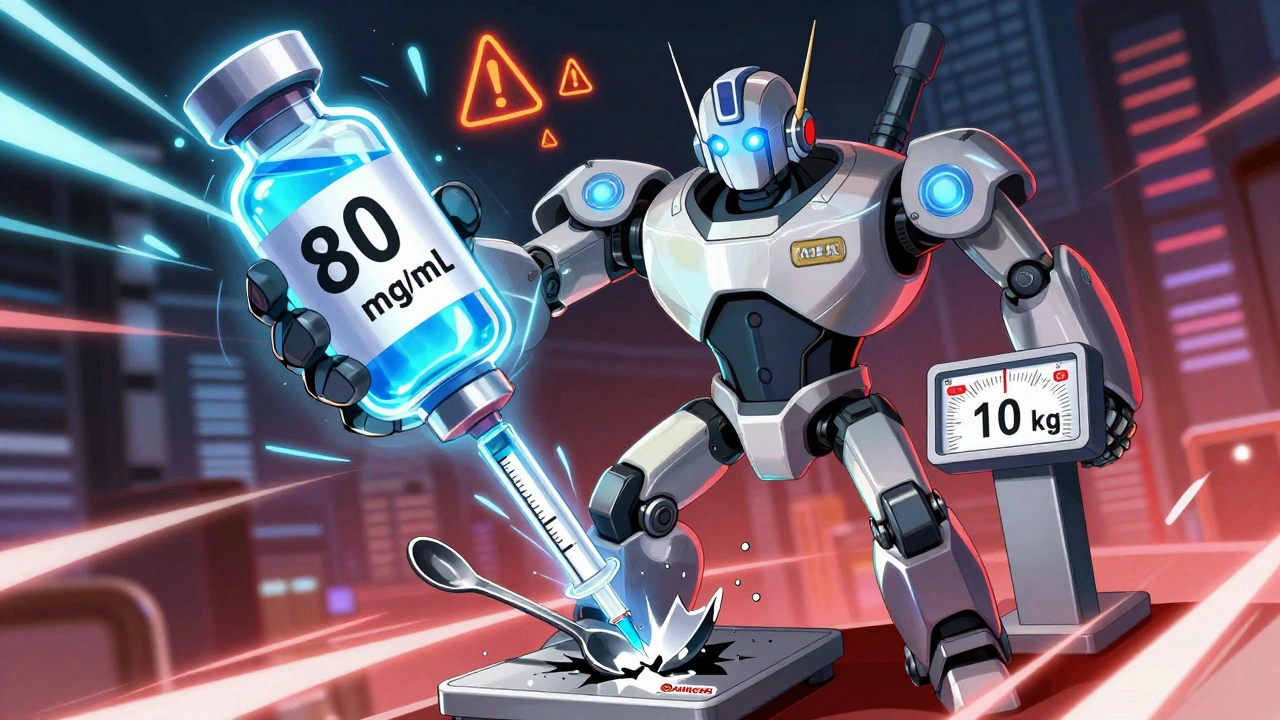
When your child gets a new prescription, the label might say 10 mL - but that’s not the dose. The real dose is 200 mg. Mixing up volume and amount is one of the most dangerous mistakes parents and even some healthcare workers make. Every year, thousands of children are at risk because the dose on the label doesn’t clearly show the correct amount in milligrams. And it’s not just about reading small print - it’s about understanding how the dose was calculated for your child’s body.
Why Pediatric Dosing Is Different
Children aren’t small adults. Their bodies process medicine differently. A dose that’s safe for a 150-pound teen could be deadly for a 20-pound toddler. That’s why pediatric dosing is always based on weight - not age, not height, not guesswork. The standard is milligrams per kilogram (mg/kg). This means the doctor calculates how much medicine your child needs based on how much they weigh in kilograms.In 2022, the Institute for Safe Medication Practices found that 56% of all pediatric medication errors were dosing mistakes. Most of these happened because someone used the wrong weight, misread the concentration, or rounded the dose incorrectly. A 2023 study in the Journal of Pediatric Pharmacology and Therapeutics showed that 18.7% of errors came from mixing up pounds and kilograms. If your child weighs 22 pounds, that’s 10 kilograms - not 22 kilograms. Get that wrong, and you could give five times too much medicine.
What to Look for on the Prescription Label
The label should show three things clearly:- The exact dose in milligrams (mg) - not just milliliters (mL)
- The child’s weight in kilograms (kg)
- The concentration of the liquid (e.g., 80 mg/mL or 160 mg/5 mL)
If any of these are missing, ask for clarification. A label that says “Give 10 mL” without saying “200 mg” is incomplete and unsafe. The FDA’s 2021 guidelines require all pediatric liquid medications to list both metric (mg) and non-metric (mL) measurements. But not every pharmacy follows this perfectly.
Look at the label like a detective. If it says “Amoxicillin 400 mg,” that’s good. But if it says “Amoxicillin 10 mL,” you need to ask: What’s the concentration? Is it 40 mg/mL? 80 mg/mL? That changes everything. A 10 mL dose of 80 mg/mL is 800 mg - four times stronger than 40 mg/mL. One mistake like that can send a child to the ER.
How to Check the Dose Yourself
You don’t need to be a pharmacist to catch an error. Here’s how to verify it in three simple steps:- Find your child’s weight in kilograms. If the label says 22 lb, divide by 2.2. That’s 10 kg. If it says 40 lb, that’s 18.2 kg. Write it down.
- Find the prescribed dose in mg/kg. The label should say something like “40 mg/kg/day.” Multiply that by your child’s weight in kg. For a 10 kg child: 40 × 10 = 400 mg per day.
- Check the daily dose against the dosing schedule. If it’s given twice a day, divide 400 mg by 2. That’s 200 mg per dose. Now look at the label: Is each dose 200 mg? If the concentration is 80 mg/mL, then 200 mg = 2.5 mL. Does the label say “Give 2.5 mL”? If it says “Give 10 mL,” something’s wrong.
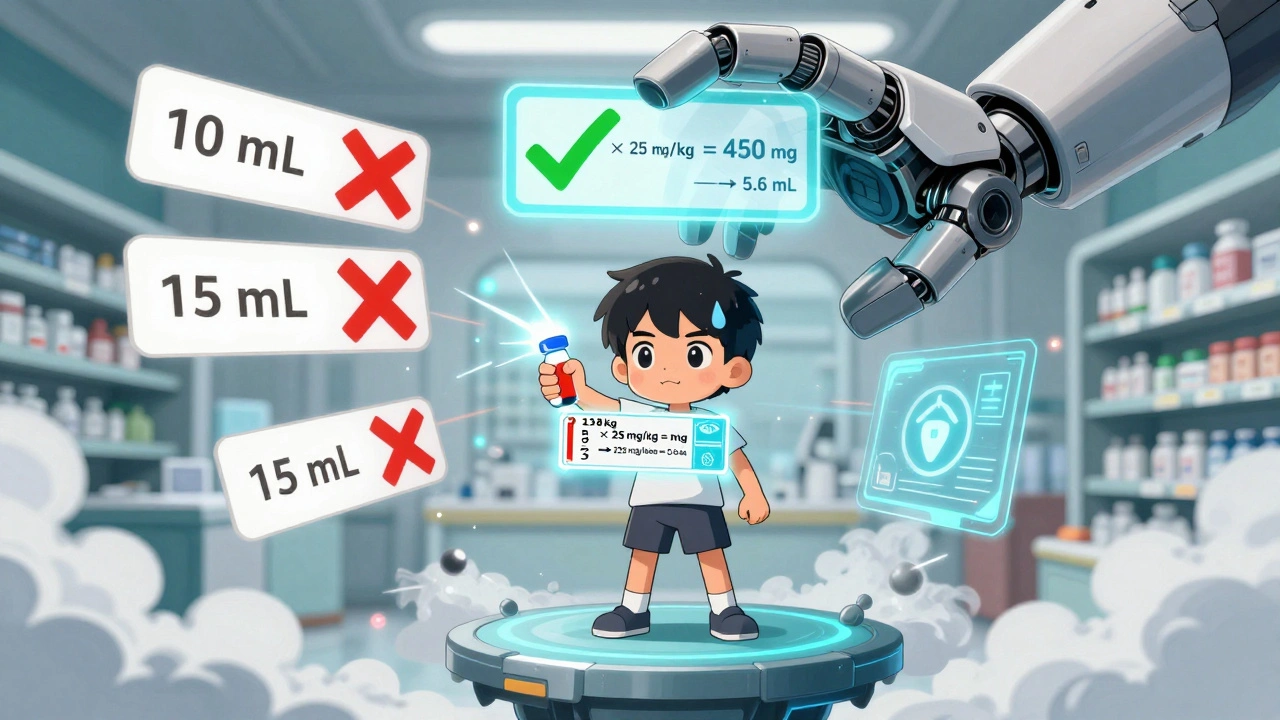
Let’s say your child weighs 18 kg and the doctor ordered 25 mg/kg of amoxicillin. That’s 450 mg per day. If it’s given twice a day, each dose is 225 mg. If the bottle says 40 mg/mL, then 225 mg ÷ 40 mg/mL = 5.6 mL. That’s not a nice round number - and that’s okay. But if the label says “Give 6 mL,” that’s 240 mg. That’s close enough for most antibiotics. But if it says “Give 10 mL,” that’s 400 mg - way too high.
Watch Out for Concentration Confusion
This is where most parents get tripped up. Two different bottles of amoxicillin can have completely different strengths. One might be 40 mg/mL. Another might be 80 mg/mL. They look the same. But if you give the same volume from each, you’re giving twice the medicine.A 2021 CDC report found that 37.2% of liquid medication errors in kids under 2 were due to concentration mix-ups. One mother in Pennsylvania nearly gave her 18-month-old a 3x overdose because she confused the 160 mg/5 mL concentration with the 80 mg/0.8 mL concentration. The label didn’t make the difference obvious. She caught it because she checked the manufacturer’s dosing chart.
Always compare the concentration on the bottle to the one listed on the prescription. If the pharmacy switched brands or used a different formulation, they should have told you. If they didn’t, ask. Say: “Is this the same concentration as what was prescribed?”
Use the Right Measuring Tool
Never use a kitchen spoon. Never guess. Always use the syringe or measuring cup that came with the medicine. Those tools are calibrated for that specific concentration. A teaspoon from your drawer holds 5 mL - but it’s not accurate. A syringe marked in 0.1 mL increments is far safer.Some doses come out to odd numbers - like 2.3 mL or 5.7 mL. That’s normal. Don’t round it up unless the pharmacist says it’s safe. For doses under 10 mg, rounding should be to the nearest 0.1 mg. For doses over 10 mg, rounding to the nearest 1 mg is acceptable. But only if the system allows it. Hospitals using EHR systems like Cerner and EPIC flag any dose that’s been rounded and show both the ordered and actual dose.
Ask the Pharmacist These Three Questions
Before you leave the pharmacy, ask:- “What is the exact dose in milligrams, not milliliters?” This forces them to confirm the amount, not just the volume.
- “Is this dose appropriate for my child’s current weight?” If they hesitate, walk away and call the doctor.
- “Can you show me how to measure this dose with the device you gave me?” Watch them do it. If they use a cup instead of a syringe, ask why.
A 2022 University of Michigan study found that pharmacists spend an average of 2.7 minutes per pediatric prescription on verification. That’s time they’re spending to keep your child safe. Use it. Don’t be shy.
When Technology Helps - and When It Doesn’t
Most hospitals now use electronic systems like EPIC or Cerner that flag wrong doses. These systems cross-check weight, age, and drug type against thousands of guidelines. One study showed EPIC’s system catches 98.7% of incorrect pediatric doses.But these systems aren’t perfect. If the weight is entered wrong - say, 22 kg instead of 10 kg - the system will approve a deadly dose. That’s why human verification still matters. The American Society of Health-System Pharmacists (ASHP) requires dual verification: two people check the dose independently. One calculates using mg/kg. The other uses a different method - like body surface area or Clark’s rule - to confirm.
Parents can be the second set of eyes. If you have a smartphone, download a trusted dosing app like DoseSpot or use the CDC’s pediatric dosing chart. Compare the label to the app. If they don’t match, call the pharmacy.

Real Stories, Real Mistakes
A Reddit thread from June 2023 tells the story of a mom whose child’s prescription said “10 mL.” She thought it was a typo. Her child weighed 18 kg. The dose should have been 200 mg. At 80 mg/mL, that’s 2.5 mL. The label said 10 mL - that’s 800 mg. Four times too much. She called the pharmacy. They admitted the pharmacist had misread the prescription. The child never took it.Another case: a 4-year-old was prescribed amoxicillin at 40 mg/kg/day. The label said 15 mL twice a day. The concentration was 40 mg/mL. That’s 600 mg per dose - 1,200 mg per day. The child’s weight was 16 kg. The correct dose was 640 mg per day. That’s 320 mg per dose - 8 mL. The label said 15 mL. That’s almost double. The parent noticed the dose seemed too high for a small child and asked for a review. The error was caught.
These aren’t rare. They happen every day. But they’re preventable.
What’s Changing in 2025
New rules are coming. As of January 1, 2024, the American Academy of Pediatrics requires all pediatric prescriptions to include the child’s weight in kilograms and the calculated dose in milligrams. No more guessing. No more assumptions.By 2025, hospitals with pediatric dosing error rates above 0.8% per 1,000 doses will face financial penalties under CMS’s Quality Payment Program. That’s pushing hospitals to invest in smarter tools - like smart pumps that auto-verify doses against weight from connected scales. Philips’ IntelliSpace platform, launching in late 2024, will do exactly that. It pulls weight data from hospital scales, checks the dose, and blocks unsafe orders.
But until every pharmacy and every parent uses these tools, you’re still the last line of defense.
Final Checklist Before Giving Medicine
Before you give your child any liquid medicine, do this:- Confirm the child’s weight is listed in kilograms (kg) - not pounds.
- Find the dose in milligrams (mg) - not just milliliters (mL).
- Check the concentration (e.g., 80 mg/mL).
- Do the math: Weight (kg) × Dose (mg/kg) = Total daily dose.
- Divide by how many times a day it’s given → that’s the dose per administration.
- Divide the dose per administration by the concentration → that’s the volume in mL.
- Compare that number to what’s on the label.
- If it doesn’t match, call the pharmacy or doctor.
It takes less than two minutes. But it could save a life.
Jack Arscott
December 2, 2025 AT 11:30Just got my kid's amoxicillin prescription today and I almost missed this. The label said '10 mL' with no mg listed. I freaked out and called the pharmacy. Turns out they used the wrong concentration. Thank god I checked. 🙏
Lydia Zhang
December 4, 2025 AT 01:41Why do pharmacies even do this
Kay Lam
December 5, 2025 AT 16:30I’ve been a pediatric nurse for 18 years and I still see this every single week. It’s not just about the labels - it’s about how the system is built. Pharmacists are rushed, doctors don’t always specify the concentration, and parents are expected to be medical experts overnight. We need standardized digital labels that auto-calculate based on weight input from the EHR. It’s not rocket science. The tech exists. We just need the will to implement it properly. And yes, parents should double-check - but they shouldn’t have to be the last line of defense against a broken system.
Matt Dean
December 6, 2025 AT 23:51Of course your kid almost died. You didn’t even know how to convert pounds to kilograms. How are you even allowed to parent?
Walker Alvey
December 7, 2025 AT 12:35They gave you a syringe? How quaint. Back in my day we used teaspoons and prayed to the medicine gods. Now we need apps and charts like we’re launching a rocket to Mars. Progress is just fear dressed up as safety.
Adrian Barnes
December 8, 2025 AT 08:19While the procedural framework presented herein is methodologically sound, it fundamentally fails to address the epistemological dissonance between clinical protocol and parental literacy. The burden of verification is disproportionately externalized onto non-clinical actors, thereby constituting a structural violation of the principle of distributive justice in healthcare delivery. This is not a parenting issue - it is a systemic failure of institutional accountability.
Linda Migdal
December 8, 2025 AT 15:06This is why America needs to stop outsourcing pharmacy work to India. I’ve seen labels in broken English with units swapped. We need American pharmacists, American training, American standards. This isn’t just about dosing - it’s about national integrity.
Tommy Walton
December 9, 2025 AT 01:28mg/kg. That’s the key. Everything else is noise. 🚀
Lucinda Bresnehan
December 9, 2025 AT 08:38Thank you for writing this. I’m a mom of twins and I used to panic every time I got a new script. I didn’t know how to read the concentration until I found a YouTube video from a pediatric pharmacist. Now I always write the math down on a sticky note. I even made a little cheat sheet for my mom who helps with daycare. It’s not perfect but it’s safer than guessing. Also - sorry for the typos, I’m typing one-handed while holding a screaming toddler.
Shannon Gabrielle
December 9, 2025 AT 17:02Oh wow another ‘check your meds’ PSA. Next they’ll tell us to breathe and drink water. Meanwhile, the same pharmacy that gave my kid 800mg instead of 200mg last month is now giving out free lollipops. The system is a circus and we’re all clowns holding the syringes.
ANN JACOBS
December 10, 2025 AT 09:30I want to extend my deepest appreciation for the meticulous attention to safety detail in this post. As a mother of three and a former hospital administrator, I have witnessed firsthand the cascading consequences of dosing errors - from near-fatal reactions to the erosion of trust in our healthcare institutions. The methodology outlined here is not merely practical; it is profoundly ethical. Every parent deserves clarity, every child deserves precision, and every pharmacist deserves the institutional support to execute their duty without systemic sabotage. Let us not treat this as a checklist - let us treat it as a covenant. Thank you for reminding us that vigilance is an act of love.