Generic Drug Shortages: When Too Much Competition Hurts Supply
 Jan, 7 2026
Every year, millions of people in the U.S. and around the world rely on generic drugs to manage chronic conditions like high blood pressure, diabetes, and depression. These medications are cheaper, widely available, and just as effective as their brand-name counterparts. But lately, something strange has been happening: the very drugs that are supposed to be abundant are disappearing from shelves. A patient might get a prescription for generic metformin, only to be told it’s out of stock. Or a hospital runs out of generic epinephrine just when a patient goes into cardiac arrest. This isn’t random. It’s the result of a broken system - where too much competition in some areas, and too little in others, is causing dangerous gaps in supply.
Competition Should Mean Lower Prices - But Not Zero Profit
The logic behind generic drugs is simple: once a brand-name drug’s patent expires, other companies can make the same medicine. More makers mean more competition, and competition means lower prices. That’s exactly what happened. In the U.S., 9 out of 10 prescriptions are now filled with generics. The savings are huge - $313 billion in 2023 alone, according to UnitedHealthcare. But here’s the catch: when prices drop too far, manufacturers stop making the drug. Take a common antibiotic like amoxicillin. A few years ago, a 500mg tablet cost about $0.10. Now, it’s down to $0.02. That’s barely enough to cover the cost of the pill’s packaging, let alone the factory, labor, testing, and regulatory compliance. When the profit margin disappears, companies walk away. And when one company leaves, the next one often follows. Suddenly, there’s only one supplier left. And if that one supplier has a quality issue - say, a failed FDA inspection - there’s no backup. That’s when shortages happen.Who Makes These Drugs? And Why Are There So Few?
Most generic drugs aren’t made in the U.S. or Europe. They’re made in India and China. That’s not because those countries are cheaper - though they are - but because they’ve built massive, specialized manufacturing networks. Companies like Sun Pharma, Aurobindo, and Lupin have factories that churn out billions of pills a year. But even in this global supply chain, the number of actual makers for any single drug is shockingly small. For example, the generic version of the heart drug digoxin has only two manufacturers left. The injectable form of the antibiotic vancomycin? Just three. And for some older, low-margin drugs like chlorpromazine or procainamide, there’s only one. According to IQVIA, 35% of generic drug markets have fewer than three active manufacturers. That’s not competition. That’s a single point of failure. The problem gets worse with complex drugs. Sterile injectables - things like insulin, chemotherapy agents, or emergency epinephrine - require clean rooms, advanced equipment, and years of regulatory approval. Setting up one facility can cost $500 million. That’s a barrier too high for most small players. As a result, just five companies control nearly half the global market for sterile injectables. When one of them shuts down for a compliance issue - and the FDA issued 147 warning letters to generic manufacturers in 2023 alone - the entire supply chain shudders.The Perfect Storm: Price Pressure Meets Regulatory Scrutiny
It’s not just about low prices. It’s about how those prices are forced down. The first company to enter a generic market often makes a killing - capturing 80% of sales at near-brand prices. Then others come in. Prices drop fast. Within a year, the drug might be selling for 10% of its original cost. That’s great for insurers. Terrible for makers. Then comes the FDA. In 2023, the agency ramped up inspections and issued more warning letters than ever before. Why? Because some manufacturers cut corners to stay profitable. They falsified data. Skipped tests. Used substandard ingredients. The FDA can’t ignore that. But when they shut down a plant, they don’t replace it overnight. The pipeline for new manufacturers is slow. Building a compliant facility takes 18 to 24 months. And few investors want to risk $500 million on a drug that might sell for pennies. The result? A vicious cycle. Low prices → fewer makers → less redundancy → higher risk of shortage → higher prices when the drug returns → more exits. It’s not that no one wants to make generics. It’s that the business model has collapsed for many of the most essential ones.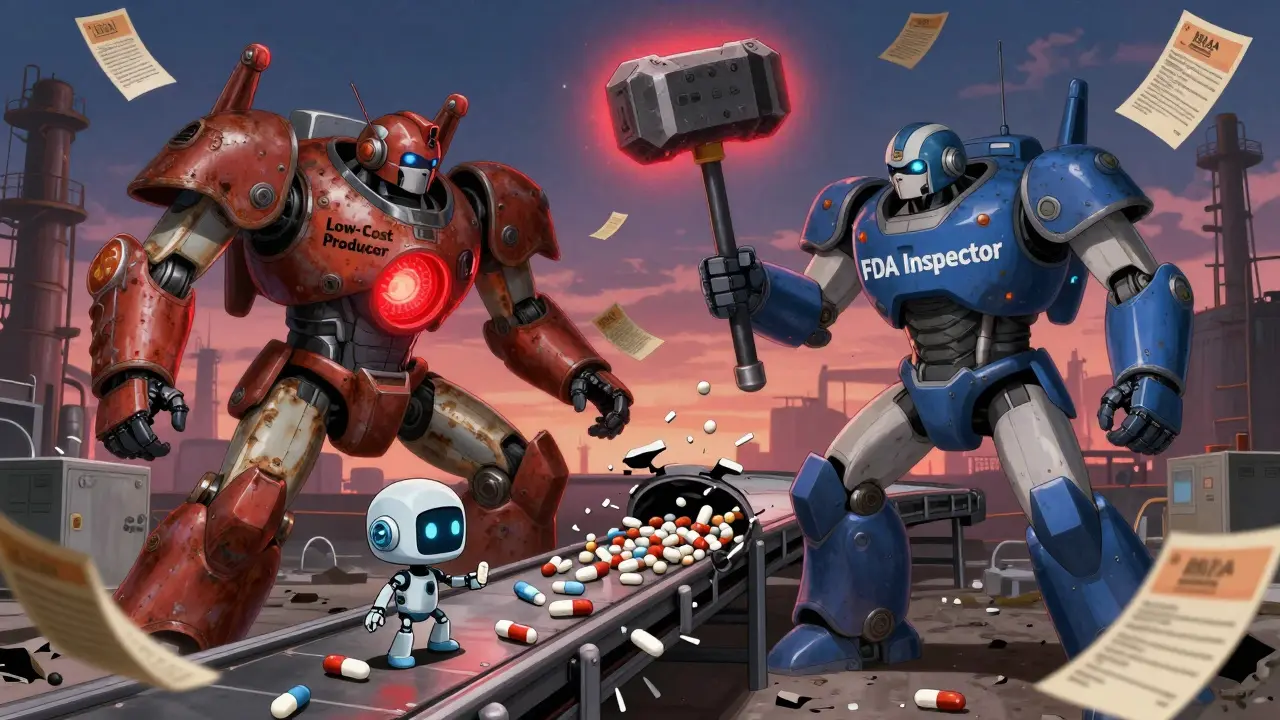
Essential Drugs Are Disappearing - And Patients Are Paying the Price
It’s not just about inconvenience. It’s about life and death. In 2023, the American Medical Association found that 78% of physicians had experienced a generic drug shortage in the past year. For 42% of them, these shortages frequently impacted patient care. Cardiovascular drugs, antibiotics, and oncology treatments are hit hardest. Imagine a patient with heart failure who needs generic furosemide. The usual version is out. The only alternative? A different brand that costs $15 instead of $2. Or worse - a substitute that’s less effective. That’s not hypothetical. It’s happening every day. Patients with chronic conditions are especially vulnerable. They can’t just switch. Their bodies are stabilized on a specific formulation. Even a small change in inactive ingredients - which is allowed under FDA rules - can cause side effects. One patient in Texas reported severe dizziness after switching to a new generic version of levothyroxine. Her doctor had to fight her insurance to get her back on the old version - which was now $40 a month instead of $4.The Global Picture: India and China Are the Backbone - But Not the Solution
India and China produce over 80% of the world’s generic drugs. They’ve built incredible scale. But their systems aren’t immune to the same pressures. When global prices fall, Indian manufacturers cut costs. When FDA inspections spike, they scramble to fix issues. But fixing a factory isn’t like fixing a leaky faucet. It takes money, time, and expertise. The European Medicines Agency says the sweet spot for supply security is 4 to 6 manufacturers per essential drug. Right now, only 65% of essential generics meet that standard. The rest? One or two makers. That’s not a market. That’s a gamble. Meanwhile, new players are emerging. But they’re focused on the high-margin stuff - biosimilars for cancer drugs, for example. These are complex, expensive to make, and still profitable. Meanwhile, the old, cheap generics - the ones millions depend on - are being left behind.
What’s Next? The Inflation Reduction Act and the Future of Generics
Starting in 2026, the U.S. government will begin negotiating prices for 10 high-cost drugs under the Inflation Reduction Act. That sounds good - until you realize many of those drugs are already generics. The government will be negotiating with the last two or three manufacturers left. And they’ll demand even lower prices. That’s a recipe for more exits. The Mordor Intelligence 2024 analysis estimates that these price negotiations could squeeze generic manufacturer margins by 15% to 25%. For companies already operating on razor-thin profits, that’s the final straw. Some experts are calling for policy changes: subsidies for essential generic manufacturers, longer exclusivity for complex generics, or even government-backed production for critical drugs. Others suggest creating strategic reserves - like a stockpile of epinephrine or insulin - to buffer against sudden shortages. But none of these solutions fix the core problem: the market doesn’t reward making cheap drugs that save lives. It rewards making expensive ones that generate profit. And right now, the system is failing the people who need the cheapest drugs the most.It’s Not About Too Many Generics - It’s About Too Few Makers
The problem isn’t that there are too many generic drugs. It’s that there are too few companies willing to make them - especially the ones that cost pennies but keep people alive. Competition is good. But when competition drives prices to zero, it kills the very system it was meant to protect. The solution isn’t to stop generics. It’s to make sure the companies that make them can survive. That means paying a fair price for essential medicines. That means recognizing that a $0.02 pill isn’t just a commodity - it’s a lifeline. And that means rebuilding a supply chain where no patient has to wait for a drug because no one is left to make it.Why do generic drug shortages happen even when there are many manufacturers?
Shortages happen because competition drives prices so low that manufacturers stop making the drug - especially if it’s an old, low-margin medicine. Even if dozens of companies make generics, only one or two may actually produce a specific drug. If that one shuts down due to a regulatory issue, there’s no backup.
Are generic drugs less safe than brand-name drugs?
No. Generic drugs must meet the same FDA standards for safety, strength, and effectiveness as brand-name drugs. The difference is in inactive ingredients - like fillers or dyes - which can sometimes cause minor side effects in sensitive patients. But the active ingredient is identical.
Why can’t we just make more generic drugs in the U.S.?
Building a compliant generic drug factory in the U.S. costs $200-500 million and takes 18-24 months to get approved. Most companies won’t invest that much in a drug that sells for pennies. The market doesn’t reward local production unless prices are high enough to justify it.
What’s being done to fix generic drug shortages?
The FDA is approving more first-time generic drugs, but inspections are also increasing. Some lawmakers are pushing for subsidies for essential generics and government stockpiles. The European Medicines Agency recommends having 4-6 manufacturers per drug - but only 65% of essential generics meet that standard globally.
How do drug shortages affect patients’ out-of-pocket costs?
When a generic runs out, patients are often switched to a brand-name version - which can cost 10 to 20 times more. Even if they get another generic, it might be from a different manufacturer with different inactive ingredients, leading to side effects. Some patients end up paying hundreds of dollars extra per month just to get the same medicine.
Annette Robinson
January 9, 2026 AT 06:19I’ve had to switch my mom’s generic blood pressure med three times in two years. Each time, she gets dizzy for a week. Her doctor says it’s the fillers, not the active ingredient-but when you’re 72 and just trying to stay upright, it feels like a gamble every month. We’re not asking for brand-name prices. We just need consistency.
These aren’t luxury drugs. They’re the reason people don’t end up in the ER. And yet, we treat them like disposable commodities.
Kristina Felixita
January 10, 2026 AT 22:27ok so like… i just found out my thyroid med changed again?? and now i’m basically a zombie?? like i know generics are supposed to be the same but the new one? nope. i cried in the pharmacy. my insurance won’t cover the old one anymore. it’s $40 now instead of $4. what even is this system??
christy lianto
January 12, 2026 AT 18:24This isn’t just about profit margins-it’s about moral bankruptcy. We let corporations chase pennies on pills that keep people alive, then act shocked when the lights go out. We have the tech, the science, the infrastructure. But we don’t have the will to value human life over quarterly earnings.
When a child can’t get their asthma inhaler because the last factory got shut down for ‘non-compliance’-that’s not a supply chain failure. That’s a policy crime.
And yes, I’m angry. You should be too.
Manish Kumar
January 13, 2026 AT 23:44You see, the real tragedy here is not the shortage-it’s the illusion of choice. We live in a world where we believe competition equals freedom, but in pharma, competition is a death sentence for the poor. The market doesn’t care about dignity, only efficiency. And efficiency, in this case, means fewer makers, fewer options, and more suffering.
India and China produce these drugs because they can tolerate the exploitation-the labor, the pollution, the regulatory corner-cutting. But when the FDA cracks down, the whole fragile ecosystem trembles. We outsourced not just production, but responsibility.
There is no free market here. There is only a market that has been hollowed out by greed and then blamed for its own collapse. The system didn’t fail. It was designed this way.
Aubrey Mallory
January 14, 2026 AT 13:42Enough with the ‘let the market decide’ nonsense. We regulate cigarettes, we regulate cars, we regulate baby formula. Why not life-saving medicine? If we can mandate airbags, we can mandate backup suppliers.
Someone needs to step in-government, nonprofit, WHO, doesn’t matter. Create a public trust for essential generics. Fund it. Protect it. Stop pretending this is a business problem. It’s a public health emergency.
And if you think patients should just ‘pay more’-you’ve never had to choose between insulin and rent.
Dave Old-Wolf
January 15, 2026 AT 10:38Wait, so if only one company makes a drug and they mess up, everyone’s out of luck? That seems crazy. Why can’t we have like, two or three just in case? Like, why is this so hard to fix?
Prakash Sharma
January 16, 2026 AT 23:36Why do Americans always blame India and China? We buy the drugs cheap because we want cheap. We don’t pay for quality-we pay for price. And now we’re surprised when the pills don’t work? We outsourced our healthcare to the lowest bidder and now we cry foul?
Stop pretending we’re victims. We’re the reason this system exists. If you want safe, reliable generics-pay for them. Don’t scream at Indian factories. Fix your own broken system.
Donny Airlangga
January 17, 2026 AT 21:57My cousin in Ohio couldn’t get his generic epinephrine during a severe allergic reaction. He had to go to the ER and got charged $1,200 for the brand-name version. He’s on disability. He didn’t have the money. They gave him a free one from a hospital stockpile, but what if they didn’t have it?
This isn’t theoretical. It’s happening to people we know.