How to Identify Counterfeit Generics and Avoid Online Scams
 Feb, 10 2026
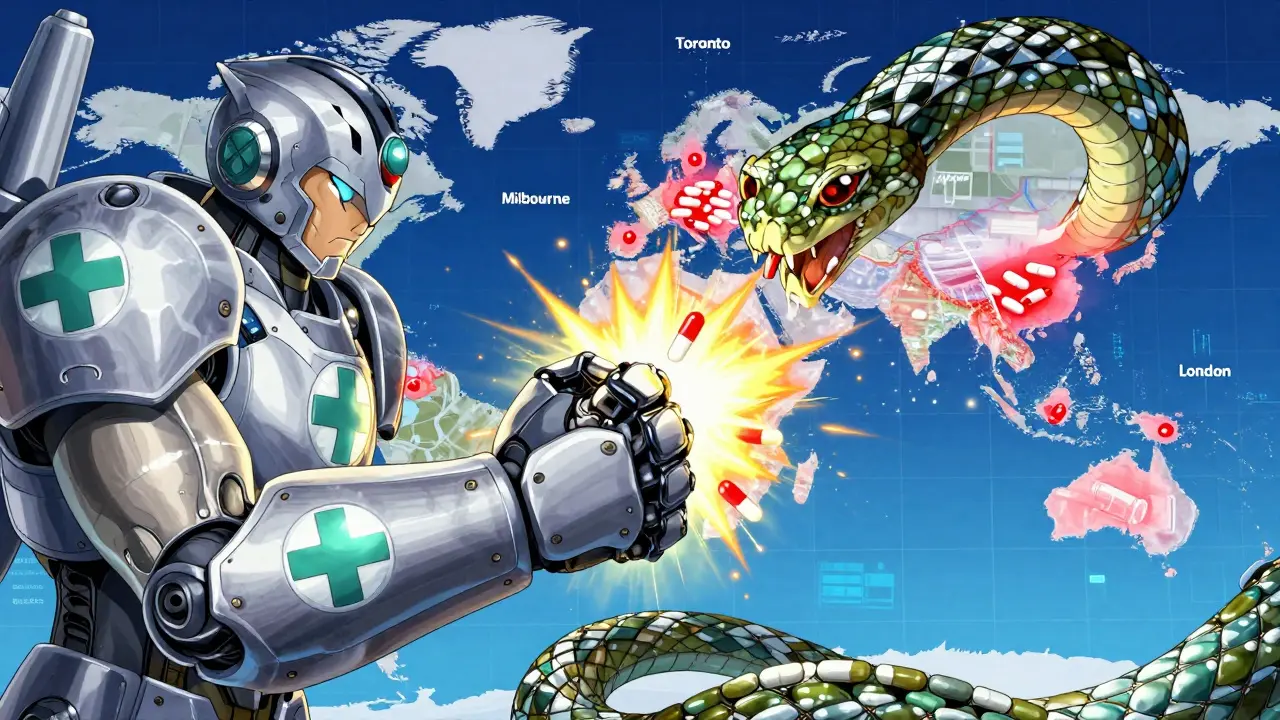
Buying medicine online sounds simple-click, pay, delivery. But what if the pills you receive aren’t what they claim to be? In 2023, the global market for counterfeit medicines was estimated at $200 billion, with more than 10% of all pharmaceuticals sold worldwide being fake. And it’s not just happening in distant countries-it’s happening right now to people in Melbourne, Toronto, London, and Sydney. The rise of e-commerce has made it easier than ever to order medications without a prescription, but it’s also made it easier for criminals to sell deadly fakes.
What Exactly Is a Counterfeit Generic?
A counterfeit generic isn’t just a cheaper version of a brand-name drug. It’s a fraud. According to the World Health Organization, these are products that are deliberately and fraudulently mislabeled. They might contain no active ingredient at all. Or worse-they might contain too much of a dangerous substance like fentanyl. Some fake pills are made from crushed drywall, rat poison, or chalk. Others are just sugar pills with fake branding.
Counterfeiters don’t just copy the pill shape-they copy the packaging, the website design, even the customer service language. Many fake online pharmacies look identical to real ones. They use similar logos, same color schemes, and even fake testimonials. The goal? To trick you into thinking you’re buying from a legitimate source.
Why Online Scams Are Getting Worse
In 2023, the DEA seized over 134 million counterfeit pills in the U.S. alone. Most of them looked like legitimate prescription drugs-oxycodone, Xanax, Adderall-but contained lethal doses of fentanyl. Between 2022 and 2023, counterfeit pill seizures jumped by 37%. And it’s not just opioids. Antibiotics, heart meds, diabetes drugs, and even eye drops like Muro 128 are being faked.
Why now? Because it’s profitable and low-risk. A single pill press costs less than $500. Fake packaging can be printed for pennies. And since most buyers don’t report counterfeit purchases-either because they’re embarrassed or they don’t realize they were scammed-the criminals keep going.
Online pharmacies that don’t require a prescription? 96% of them are illegal, according to the National Association of Boards of Pharmacy. And 88% of those don’t even check if you have a valid prescription. That’s not convenience-that’s a trap.
How to Spot a Fake Medicine (Even If You’re Not a Scientist)
You don’t need a lab to spot red flags. Here’s what to look for:
- Change in appearance: If your pills look different-color, shape, size, markings-compared to your last refill, stop taking them. Even small differences matter.
- Packaging errors: Typos, blurry logos, wrong font, mismatched batch numbers, or missing expiration dates are huge warnings. Real manufacturers don’t mess this up.
- Unusual side effects: If you’ve never had nausea, dizziness, or burning sensations before, but you get them after starting a new batch of meds, that’s a sign something’s wrong.
- Too-good-to-be-true prices: If a pharmacy offers 80% off brand-name drugs, it’s fake. Legitimate pharmacies don’t undercut prices that much. If it’s too cheap, it’s not real.
- No pharmacist on call: A real online pharmacy always has a licensed pharmacist available to answer questions. If you can’t talk to one, walk away.
One Reddit user, u/MedSafety101, bought what they thought was sildenafil (Viagra) from a site that didn’t end in .pharmacy. The pills dissolved in water in under 30 seconds. The real version takes 20 minutes. That’s a clear sign the active ingredient wasn’t even properly formulated.
The Only Reliable Way to Verify an Online Pharmacy
The most effective tool you have? The .pharmacy domain.
Since 2018, the National Association of Boards of Pharmacy (NABP) has run a verified website program. Only pharmacies that meet strict licensing, safety, and operational standards get this domain. It’s not just a logo-it’s a certification. Look for it at the end of the website address: www.example.pharmacy.
That’s it. No exceptions. No “we’re licensed in Canada” or “we’re partnered with a U.S. pharmacy.” If the website doesn’t end in .pharmacy, it’s not verified. Period.
Also check:
- Does the site list a physical address? Call it. Real pharmacies have real offices.
- Can you speak to a pharmacist? If they only offer chatbots or automated emails, it’s fake.
- Do they require a valid prescription? If they sell controlled substances without one, they’re breaking the law.
Trustpilot reviews show that verified .pharmacy sites average 4.7 out of 5 stars. Unverified sites? 2.1. That gap tells you everything.
What to Do If You Suspect a Counterfeit
If you think you’ve received fake medicine:
- Stop taking it. Even if it seems to work, it could be poisoning you.
- Save everything: The pills, the packaging, the receipt, the website screenshot. These are evidence.
- Call the manufacturer. Pfizer, Johnson & Johnson, and other major companies track counterfeit reports. Give them the lot number and batch code. They’ll tell you if it’s real.
- Report it: In Australia, contact the Therapeutic Goods Administration (TGA). In the U.S., report to the FDA. Globally, the WHO’s Global Surveillance and Monitoring System (GSMS) collects reports from 141 countries.
Don’t assume it’s just a one-off. Fake meds are part of a network. Reporting helps shut them down.
Why You Can’t Rely on Apps or QR Codes Alone
You’ve probably seen ads for apps that scan QR codes to verify medicine. They sound great. But here’s the truth: counterfeiters are using real QR codes. They copy them. They print them. They even clone the packaging exactly.
The MediGuard app scanned over 1.2 million products in 2023 and had 92.4% accuracy. That sounds good-but 7.6% is still thousands of fake pills slipping through. And if the QR code is on a fake package, the app will say “valid” because it’s reading a copy of a real code.
Same with holograms, color-shifting ink, and UV markings. Sophisticated counterfeiters now replicate these using professional printing tools. They’ve studied the real packaging for months. What looks like a security feature to you? To them, it’s a challenge.
Technology helps. But it’s not a guarantee. Your best defense is still common sense and verified sources.
Real Stories, Real Risks
A woman in Sydney bought “generic” blood pressure medication from a website that looked like her local pharmacy. She took it for two weeks. Then she collapsed. Her hospital tests showed the pills had no active ingredient. Her blood pressure spiked dangerously. She almost had a stroke.
A man in Toronto bought “Adderall” online to help with focus. He didn’t know it contained fentanyl. He died in his sleep.
These aren’t rare cases. They’re becoming routine. The FDA received over 1,200 consumer complaints in 2023 about counterfeit drugs. Seventy-three percent of those involved unexpected side effects or no effect at all.
Counterfeiters don’t care if you’re young, old, rich, or poor. They only care if you’re trusting.
How to Stay Safe in 2026
Here’s your simple checklist:
- Only buy from .pharmacy websites. That’s the single most effective filter.
- Never buy prescription meds without a valid prescription. If they don’t ask for one, they’re not legit.
- Compare packaging. Keep your last bottle. Look side-by-side with the new one.
- Don’t trust prices. If it’s 50% cheaper than your local pharmacy, it’s fake.
- Call the manufacturer. If you’re unsure, they’ll tell you. They want to know if their products are being faked.
- Report suspicious sites. One report can help shut down a network.
Remember: there’s no shortcut to safety. No app, no hack, no miracle scan. Just one rule: if it doesn’t end in .pharmacy, don’t buy from it.
Can I trust online pharmacies that say they’re licensed in another country?
No. Licensing in another country doesn’t mean they’re safe for you. Regulations vary widely. A pharmacy licensed in India or Mexico may not meet Australian, U.S., or EU safety standards. Only .pharmacy verified sites are checked against international safety benchmarks. Anything else is a gamble.
Do generic drugs ever look different from the brand name?
Yes-but only in ways allowed by law. Generic drugs must have the same active ingredient, strength, and dosage as the brand. But they can look different in color, shape, or markings because trademark laws prevent them from copying the exact appearance. If your generic suddenly changes color or shape from one refill to the next, that’s a red flag. Contact your pharmacist.
What if I already took a fake pill? What should I do?
Stop taking the rest immediately. If you feel unwell-dizziness, nausea, chest pain, confusion-seek medical help right away. Bring the pills and packaging with you. Report the incident to your national health authority. Even if you feel fine, fake meds can have delayed effects. Some contain toxins that build up over time.
Are all online pharmacies bad?
No. But 96% of them are illegal. The 4% that are legal are the ones verified by the NABP with the .pharmacy domain. These pharmacies are inspected, require prescriptions, employ licensed pharmacists, and follow strict safety rules. Stick to those. Avoid all others.
Can I get fake meds from a real pharmacy?
It’s rare, but possible. Counterfeiters sometimes infiltrate supply chains. That’s why the TGA and FDA test suspicious products in labs. If you notice unusual changes in your medication-color, smell, texture-contact your pharmacist. They can check with the manufacturer. Most real pharmacies will replace the product immediately if they suspect it’s fake.
Ojus Save
February 10, 2026 AT 17:31Jonathan Noe
February 11, 2026 AT 16:08Autumn Frankart
February 13, 2026 AT 12:26Carla McKinney
February 14, 2026 AT 19:19Jim Johnson
February 16, 2026 AT 12:56Pat Mun
February 18, 2026 AT 06:01Rachidi Toupé GAGNON
February 18, 2026 AT 08:07Skilken Awe
February 19, 2026 AT 08:18andres az
February 21, 2026 AT 07:14Stephon Devereux
February 21, 2026 AT 20:52Steve DESTIVELLE
February 23, 2026 AT 08:11Neha Motiwala
February 23, 2026 AT 18:44Vamsi Krishna
February 24, 2026 AT 10:38Suzette Smith
February 26, 2026 AT 01:16