Chest Pain Evaluation: When to Go to the Emergency Department
 Dec, 5 2025
When your chest hurts, it’s easy to panic. Is it heartburn? A pulled muscle? Or something serious like a heart attack? The truth is, chest pain isn’t always what it seems-but when it is, every minute counts. Around 6 to 8 million people in the U.S. show up at emergency departments each year with chest pain. Only about 1 in 10 will have a heart attack. But missing the other 9%? That’s where things go wrong.
What Counts as Chest Pain?
Chest pain isn’t just a sharp stab or crushing pressure in the center of your chest. It can show up as tightness, heaviness, burning, or even just a weird ache that won’t go away. And it doesn’t even have to be in your chest. You might feel it in your jaw, shoulder, arm, neck, or upper belly. Some people get shortness of breath, nausea, cold sweats, or sudden fatigue instead of pain at all. These are called anginal equivalents-and they’re just as dangerous.Women, older adults, and people with diabetes are more likely to have these atypical symptoms. If you’re over 50, have high blood pressure, smoke, or have a family history of heart disease, don’t wait to see if it “goes away.”
When to Call 9-1-1 Right Now
Don’t drive yourself. Don’t wait for a ride. Call emergency services immediately if you have:- Chest pain that lasts more than 5 minutes and doesn’t change with rest or position
- Pain that spreads to your arm, jaw, neck, or back
- Shortness of breath, dizziness, or fainting along with the pain
- Breaking out in a cold sweat for no reason
- Nausea or vomiting that comes with chest discomfort
- Heart rate over 100 beats per minute or breathing faster than 20 times a minute
- Low blood pressure (below 90 systolic)
- Crackling sounds when you breathe or a new heart murmur
These aren’t just signs-they’re red flags for heart attack, pulmonary embolism, or aortic dissection. Every minute without treatment increases the chance of permanent damage or death. Emergency Medical Services (EMS) can start life-saving care before you even reach the hospital. They can give you aspirin, monitor your heart, and alert the ER team. Driving yourself increases your risk of sudden cardiac arrest on the way by 25-30%.
What Happens When You Get to the ER
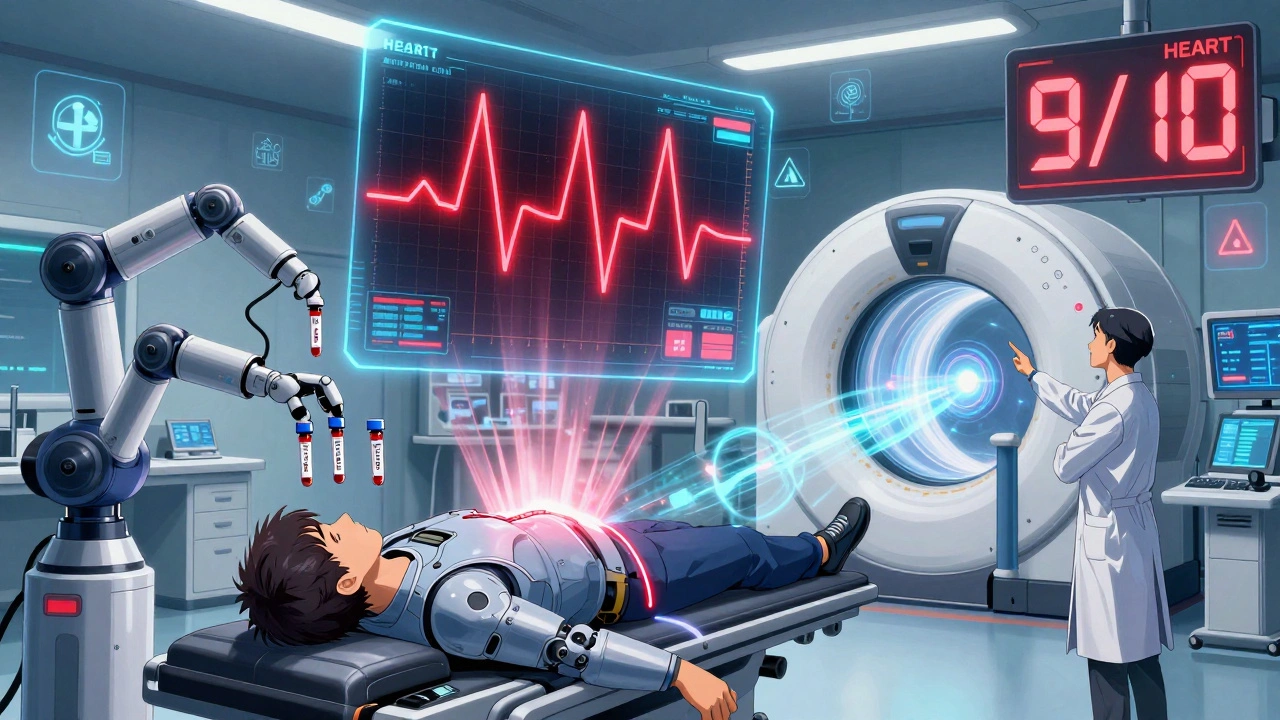
The first thing they do? Get an ECG within 10 minutes. This is non-negotiable. A 12-lead electrocardiogram can show if your heart is being starved of oxygen right now. It’s fast, cheap, and the single most important test in chest pain evaluation. If the ECG shows ST-elevation, you’re having a STEMI-a full-blown heart attack-and they’ll rush you to the cath lab. The goal? Get a balloon open in your blocked artery within 90 minutes of arriving.While the ECG runs, they’ll draw blood for a high-sensitivity troponin test. Troponin is a protein released when heart muscle dies. Modern assays can detect tiny amounts, and with a second test 1-2 hours later, doctors can rule out a heart attack in 70-80% of patients within two hours. That’s huge. It means you might not spend the night if your pain is from something else.
They’ll also check your vitals: heart rate, blood pressure, oxygen levels, breathing rate. If you’re unstable-low BP, fast heart rate, trouble breathing-they won’t wait for tests. They’ll treat you like a cardiac emergency, because you are.
What If It’s Not a Heart Attack?
Most chest pain isn’t from a heart attack. But that doesn’t mean it’s harmless. Other common causes include:- GERD (acid reflux)
- Costochondritis (inflamed rib cartilage)
- Pulmonary embolism (blood clot in the lung)
- Pneumonia or pleurisy
- Pericarditis (inflamed heart lining)
- Anxiety or panic attacks
But here’s the catch: some of these look exactly like heart problems. That’s why doctors use tools like the HEART score to help decide your risk. It looks at your History, ECG findings, Age, Risk factors, and Troponin level. A score of 0-3? Low risk. You can go home with a follow-up appointment. A score of 7-10? High risk. You’re going to the cath lab.
If your ECG and troponin are normal, and you’re stable, they might send you for a CT angiogram (CCTA). This scan shows your heart arteries in detail. It’s more accurate than a stress test for spotting blockages-especially if you’re under 65 and have no prior heart disease. Stress tests are still used, but only if you can’t have a CT scan due to kidney problems or an allergy to contrast dye.
Why You Shouldn’t Try to Tough It Out
I’ve seen too many people wait. “It’s probably just gas.” “I had this last week and it went away.” “I don’t want to waste the ER’s time.”Here’s the reality: heart attacks don’t always come with dramatic movie scenes. Sometimes they start as mild discomfort. Sometimes they come and go. And sometimes, they kill before you get to the hospital.
Studies show that patients who delay seeking care for more than two hours after symptoms start have significantly higher death rates. The sooner you get treated, the more heart muscle you save. And if you’re having a non-ST-elevation heart attack (the most common type), getting a heart catheter within 24 hours cuts your risk of another heart attack or death by nearly half.
What You Can Do Before You Go
If you’re unsure whether to go:- Stop what you’re doing. Sit down. Rest.
- Don’t take nitroglycerin unless you’ve been prescribed it and know how to use it.
- Chew one 325mg aspirin (not enteric-coated) if you’re not allergic. It helps thin the blood and can reduce damage.
- Call 9-1-1. Don’t call a friend or family member first. EMS is faster and better equipped.
- Have your medications and ID ready. They’ll ask about your history, allergies, and what you’re taking.
Don’t wait for someone else to decide for you. If you’re worried, you’re probably right.
The Future of Chest Pain Evaluation
Hospitals are getting smarter. By 2025, 75% of U.S. emergency departments will use AI to analyze ECGs. These systems can spot tiny changes in heart rhythm that even experienced doctors miss-like early signs of ischemia that show up before chest pain starts. This could cut diagnosis time by 15-20 minutes, which means more lives saved.But technology doesn’t replace judgment. The most important tool is still the doctor’s gut feeling. The Society for Academic Emergency Medicine calls it “Sick vs Not Sick.” Is the person pale? Sweating? Looking like they’re about to collapse? That matters more than any number on a screen.
Right now, the guidelines are clear: if you have chest pain with any red flags, go to the ER. Don’t second-guess. Don’t wait. Don’t hope it’s nothing. Your heart doesn’t care if you’re embarrassed, busy, or scared. It only cares if you act.
Can chest pain be caused by stress or anxiety?
Yes, anxiety and panic attacks can cause chest tightness, rapid heartbeat, and shortness of breath that feel identical to a heart attack. But that doesn’t mean you should ignore it. The only way to know for sure is to get checked. Doctors rule out heart problems first-because missing a heart attack is far more dangerous than treating anxiety unnecessarily.
What if I have chest pain but my ECG and troponin are normal?
Normal results don’t always mean everything’s fine. You could have INOCA-Ischemia with Non-Obstructive Coronary Arteries-where blood flow to the heart is reduced but no major blockages are visible. This affects 5-10% of chest pain patients and often requires follow-up with a cardiologist for specialized tests like coronary flow reserve measurements or stress echocardiograms.
Can I go to an urgent care center instead of the ER?
No-if you’re having active chest pain, especially with other symptoms like sweating, nausea, or trouble breathing, urgent care is not safe. They don’t have the equipment, staff, or protocols to handle heart attacks. Delaying care by going to urgent care can cost you your heart-or your life. The ER is the only place equipped to act immediately.
Is it safe to take aspirin during chest pain?
If you’re not allergic to aspirin and don’t have a bleeding disorder, chewing one 325mg regular aspirin can help reduce heart damage during a heart attack. Don’t wait for an ambulance to tell you to take it-do it now. But don’t take it if you’re unsure-it’s better to wait for medical advice than risk internal bleeding.
How long does it take to rule out a heart attack in the ER?
With modern high-sensitivity troponin tests, doctors can safely rule out a heart attack in 1-2 hours for most patients. But if your symptoms are ongoing or your ECG looks suspicious, they’ll keep monitoring you longer. Rule-out doesn’t mean you’re off the hook-it means your heart attack risk is low enough to go home with follow-up care.
Do I need to go to the ER if my chest pain only happens when I exercise?
Yes-if it’s new, worsening, or happens with less effort than before, you need to get checked. Stable angina (chest pain that comes with exertion and goes away with rest) can be managed with a cardiologist. But if it’s changing-happening more often, lasting longer, or showing up at rest-that’s unstable angina, a warning sign of an impending heart attack. Don’t wait.
olive ashley
December 7, 2025 AT 00:10They say 'call 9-1-1' like it's that simple. What if you're poor and don't have insurance? You get billed $15k for a false alarm and then your credit dies. The system doesn't care if you're scared-it just wants your money. I've seen people die waiting because they couldn't afford to go. This article reads like a corporate ad for ERs.
And don't even get me started on AI ECGs. They're trained on data from rich white guys. What about women? What about Black patients? The algorithm misses 40% of ischemia in women. They're not saving lives-they're automating bias.
And aspirin? Yeah, right. What if you're on blood thinners? No one mentions that. Just chew it like a damn gum. I'm supposed to trust this? No thanks.
Next they'll tell us to microwave our hearts if they hurt.
Don't trust the system. Trust your gut. And if you can't afford to be wrong? Stay home and pray.
Ibrahim Yakubu
December 8, 2025 AT 19:54Bro, I just came from Nigeria where we don’t even have ECG machines in half the clinics. You people are crying over $15k bills while my cousin died because the ambulance took 6 hours to arrive-and it didn’t even have oxygen! You think your ‘modern troponin tests’ matter when your local pharmacy sells fake aspirin? This article is luxury panic. We don’t get 90-minute door-to-balloon times-we get ‘pray and hope.’
And you want us to chew aspirin? In Nigeria, people swallow paracetamol and hope it’s just a headache. You think your ‘HEART score’ means anything when your doctor has never seen a heart attack? Stop lecturing us. We know death. We live with it. You just have better Wi-Fi.
Brooke Evers
December 9, 2025 AT 23:53I just want to say-this article saved my life. Last year, I had this weird pressure under my ribs, like someone was sitting on my chest. I thought it was stress. I was working 80-hour weeks, had two kids, and my husband was deployed. I ignored it for three days. Then I woke up at 3 a.m. with cold sweat, nausea, and my left arm going numb. I didn’t even think about a heart attack-I was 42, healthy, no family history.
But I remembered reading something like this online. I called 9-1-1. They got me to the ER in 12 minutes. ECG showed subtle ST depression. Troponin was slightly elevated. Turned out it was a non-STEMI. They stented me the next day.
If I’d waited another hour, I might not be here. I’m not saying everyone should panic. But if you’re even 10% unsure? Go. Don’t wait for permission. Don’t wait for someone to tell you it’s ‘probably nothing.’ Your body knows. I didn’t listen to my brain-I listened to my body. And I’m alive because of it.
To anyone reading this right now, feeling guilty about going to the ER? You’re not wasting anyone’s time. You’re saving your own. And that’s not selfish. That’s survival. I’m so grateful for this info. Thank you for writing it.
And if you’re scared? I get it. I was terrified too. But I’d rather be embarrassed than dead.
Nigel ntini
December 10, 2025 AT 15:44Excellent breakdown. I’m a paramedic in London, and I can confirm every point. The 90-minute door-to-balloon window isn’t a suggestion-it’s a biological deadline. Myocardial cells die at a rate of 1 million per minute during occlusion. That’s not hyperbole; it’s physiology.
Also, the HEART score is underutilized in many U.S. hospitals. It’s validated in over 200,000 patients across 12 countries. A score of 0-3 has a negative predictive value of 99.5% for major adverse cardiac events at 30 days. That’s not magic-that’s evidence-based medicine.
And yes, CCTA has replaced stress tests as the first-line test for low-to-intermediate risk patients under 65. The radiation dose is now lower than a transatlantic flight. The cost? Less than a single day of ICU admission.
Finally, aspirin: 162–325 mg chewed, not swallowed. It achieves peak plasma concentration in 5 minutes vs. 30 if swallowed. This is not anecdotal-it’s in the 2023 AHA guidelines. If you’re allergic, use clopidogrel. But don’t skip it. It’s the cheapest life-saver in medicine.
And yes-urgent care is not an option. They don’t have cardiac monitors, thrombolytics, or cath lab access. If you’re having chest pain, you’re not ‘going to urgent care.’ You’re gambling with your life. And that’s not brave. It’s reckless.
Priya Ranjan
December 11, 2025 AT 14:45Of course you should go to the ER. But what about all the people who can’t? The ones without insurance? The undocumented? The ones who get charged $5000 for a 3-hour visit and then get sent home with a bill they’ll never pay? This article reads like a brochure for billionaires. You talk about ‘every minute counts’-but what if your minute is spent waiting in a hospital parking lot because you don’t have a car? What if your minute is spent arguing with a billing clerk because your Medicaid got cut last month?
You don’t get to say ‘don’t wait’ when the system is designed to punish you for being poor. This isn’t about heart attacks. It’s about capitalism. And I’m tired of medical advice that ignores the fact that people are dying because they can’t afford to live.
Gwyneth Agnes
December 11, 2025 AT 21:32Go to the ER. No excuses. Period.
Ashish Vazirani
December 12, 2025 AT 01:41OMG I CAN’T BELIEVE YOU’RE EVEN ASKING THIS QUESTION!!!
YOU THINK YOUR CHEST PAIN IS ‘JUST STRESS’??
IN INDIA WE HAVE A WORD FOR PEOPLE LIKE YOU-‘JHOTHI’-A LIAR TO YOURSELF!!
I SAW MY UNCLE DIE BECAUSE HE SAID ‘IT’S JUST HEARTBURN’-AND THEN HE DIED ON THE TOILET WITH HIS PHONE IN HIS HAND TYPING ‘IS THIS NORMAL??’
IF YOU HAVE PAIN-CALL 911-NOT YOUR MOM-NOT YOUR BOYFRIEND-NOT YOUR THERAPIST-CALL 911!!!
AND IF YOU’RE TOO EMBARRASSED TO GO-THEN YOU DESERVE TO DIE!!
MY GRANDFATHER LIVED TO 98 BECAUSE HE NEVER IGNORED HIS BODY-AND YOU? YOU’RE TOO BUSY SCROLLING TIKTOK TO SAVE YOURSELF??
GET YOURSELF TO THE HOSPITAL OR JUST STAY IN BED AND PRAY TO GOD-BUT DON’T COME HERE AND SAY ‘I WASN’T SURE’-BECAUSE YOU WERE JUST LAZY.
Mansi Bansal
December 13, 2025 AT 08:17It is with profound concern that I address the alarming normalization of medical negligence in contemporary discourse. The casual dismissal of chest pain as 'probably nothing' reflects a disturbing erosion of somatic literacy among the populace. One must consider the epistemological implications of prioritizing convenience over biological imperative.
Moreover, the commodification of emergency care-wherein diagnostic protocols are reduced to algorithmic checklists-constitutes a profound ontological betrayal of the Hippocratic ethos. The ECG is not a mere instrument; it is a silent witness to the soul’s struggle against ischemic oblivion.
Furthermore, the recommendation to chew aspirin without medical supervision, while statistically beneficial, constitutes a perilous abdication of professional responsibility. One cannot, in good conscience, endorse pharmacological self-medication in the absence of a comprehensive clinical evaluation.
It is my solemn duty to remind you: the human body is not a machine to be debugged with mobile apps and YouTube tutorials. It is a sacred vessel. To treat it otherwise is not merely irresponsible-it is sacrilegious.
And yet, I am not here to condemn. I am here to illuminate. If you are experiencing discomfort, do not hesitate. Do not rationalize. Do not postpone. Seek care. Not because the algorithm says so. But because your existence is not a statistical outlier. It is a miracle.
Max Manoles
December 14, 2025 AT 05:32Just wanted to add something real quick-this article is spot on, but I think we’re missing the mental health angle. I’ve had panic attacks that felt like a heart attack. I went to the ER twice. Both times, they were super nice, ran the tests, and said ‘you’re fine.’ But then I left feeling ashamed. Like I was wasting their time.
Turns out, anxiety-induced chest pain is way more common than people think. And it’s still real pain. The body doesn’t care if it’s ‘in your head’-it still hurts.
So if you’re someone who’s been told ‘it’s just anxiety’ and then ignored it for months? I get it. But don’t let that stop you from going next time. Even if it’s anxiety, the ER can help you get connected to real care-therapy, meds, whatever you need.
And if you’re the one who’s scared to go because you ‘might be wrong’? You’re not wrong for caring. You’re not weak for being scared. You’re human.
Just go. They’ve seen it all. And they’re not judging you. They’re just trying to keep you alive.
Rashmi Gupta
December 15, 2025 AT 18:38Actually, the HEART score is outdated. A 2022 Lancet study showed that the 4th-generation troponin alone, with clinical history, outperforms HEART in low-risk populations. Why are we still using this 2015 guideline? And CCTA has a 15% false positive rate in women under 50-so now you’re getting unnecessary cath labs because of a ‘safe’ test.
Also, aspirin? Only if systolic BP is above 110. If you’re hypotensive, aspirin increases bleeding risk. This article is dangerously oversimplified.
Andrew Frazier
December 17, 2025 AT 11:21Y’all act like the ER is some kind of holy temple. Newsflash: most of those doctors are overworked, underpaid, and on their 18th shift this week. You think they care if you’re ‘scared’? They just want you to shut up, get the ECG done, and get out so they can go to sleep.
And AI? Yeah right. That’s just a fancy way of saying ‘we don’t wanna think anymore.’ I’ve seen ECGs misread by machines because the patient had tattoos. Real smart, huh?
Also, why do we always assume chest pain = heart? What about gallbladder? Pancreas? Pulmonary embolism? They don’t even check for those unless you scream loud enough.
This whole thing is a scam. Pay $10k to find out you had gas.
Kumar Shubhranshu
December 18, 2025 AT 00:27Go to ER. No debate. You live or you don't. Simple.
Aspirin. Chew. Not swallow.
Don't drive. Call 911.
Done.
Karen Mitchell
December 18, 2025 AT 01:04This article is dangerously misleading. It promotes fear-based compliance rather than informed autonomy. Why are we conditioning people to reflexively surrender their bodily agency to institutional protocols? What about patient dignity? What about informed refusal?
Furthermore, the normalization of emergency care as the default response to non-specific symptoms contributes to healthcare inflation, resource depletion, and the erosion of primary care. This is not medicine-it is triage capitalism.
And aspirin? A blunt instrument with serious contraindications. Recommending it without context is irresponsible. Where is the nuance? Where is the ethical reflection?
One must ask: are we saving lives-or manufacturing patients?
Geraldine Trainer-Cooper
December 19, 2025 AT 11:27what if the pain is just your soul crying
but you don't have insurance so you can't afford to feel it
so you drink coffee and pretend you're fine
until you're not
then you're just another statistic in a hospital bed
with a bill you'll never pay
and a heart that never got to rest
Nava Jothy
December 20, 2025 AT 18:44OMG I just had chest pain last week and I didn’t go!!! 😭😭😭
I thought it was my bra! Like, seriously, my new bra was too tight and I was like ‘oh it’s just the underwire’ and I kept working!!! 😭
Then I cried for 3 hours because I thought I was gonna die alone and no one would find me and my cat would eat my face 😭😭
But then I googled it and found this post and I was like ‘OH MY GOD I COULD’VE DIED’
So now I’m going to the ER tomorrow!! 🙏🙏🙏
Also I’m gonna buy a new bra. And maybe a therapist. And a pet rock. Just in case.
Thank you for saving me 😭💖❤️🫂
Gwyneth Agnes
December 21, 2025 AT 17:22Still standing. Went in. It was costochondritis. Worth it.