Migraine Medications: Triptans, Gepants, and Ditans Safety Compared
 Jan, 3 2026
When a migraine hits, you don’t want to waste time guessing which pill will work - or which one might put you out of commission for hours. The three main classes of acute migraine meds - triptans, gepants, and ditans - each offer relief, but their safety profiles couldn’t be more different. Choosing the right one isn’t just about speed or cost. It’s about what your body can handle.
Triptans: Fast, But Not Without Risk
Triptans like sumatriptan, rizatriptan, and almotriptan have been the go-to for decades. They work fast - often cutting pain in half within 30 to 60 minutes. That’s why they still make up 62% of all acute migraine prescriptions. But that speed comes with trade-offs.
The biggest concern? Vasoconstriction. Triptans activate serotonin receptors that tighten blood vessels. That’s how they stop migraine pain. But if you have high blood pressure, heart disease, a history of stroke, or even uncontrolled migraines with aura, this could be dangerous. Guidelines from the American Academy of Family Physicians are clear: avoid triptans if you have any cardiovascular risk.
Even for healthy people, side effects are common. About 1 in 6 users feel chest tightness - not a heart attack, but close enough to scare you. Tingling, flushing, dizziness, and fatigue show up in 5-15% of cases. Subcutaneous injections cause injection-site pain in 40% of users. Nasal sprays leave a bitter aftertaste for about a quarter of people.
And here’s something most don’t realize: some symptoms you blame on the drug might actually be part of the migraine itself. Feeling tired? Weak? Dizzy? Those can be migraine aura symptoms, not drug reactions. That’s why The Medical Letter warns doctors to look closely before labeling a side effect.
Gepants: The Quiet Contender
Gepants - like ubrogepant (Ubrelvy) and rimegepant (Nurtec ODT) - are newer. They block CGRP, a protein linked to migraine pain, without touching blood vessels. That’s why they’re considered much safer for people with heart conditions. In fact, the American Headache Society now recommends gepants over triptans for those with cardiovascular risks.
Side effects? Minimal. Nausea affects only 4-6% of users. Drowsiness? Around 2-4%. One rare case of allergic reaction was reported with rimegepant - just 0.1% of users. No chest pressure. No blood vessel tightening. No warnings against driving.
But there’s a catch: they’re slower. Triptans often work in under an hour. Gepants take 1-2 hours to kick in. That’s fine if you’re at home and can wait. Not so great if you’re stuck in a meeting or need to drive. Still, many users prefer the gentler experience. On Drugs.com, rimegepant has a 7.1/10 rating - higher than most triptans. One user wrote: "No chest pressure like with triptans, just takes longer to work."
Another perk? Rimegepant is also approved for preventive use - you can take it every other day to reduce attack frequency. That’s rare for an acute medication. And unlike triptans, you can take gepants within 24 hours of other migraine drugs like dihydroergotamine.
Ditans: Effective, But Too Sedating
Lasmiditan (Reyvow) is the only ditan on the market. It works differently - targeting the 5-HT1F receptor in the brain, not blood vessels. That means no vasoconstriction. Safe for heart patients. Great on paper.
But here’s the problem: it hits your brain too hard. In clinical trials, nearly 19% of users on the 100mg dose reported dizziness. Nearly 10% had paresthesia - that pins-and-needles feeling. Sedation hit 7.8%. Incoordination? 3.2%. Cognitive fog? 2.8%. One Reddit user summed it up: "Reyvow made me feel drunk without alcohol."
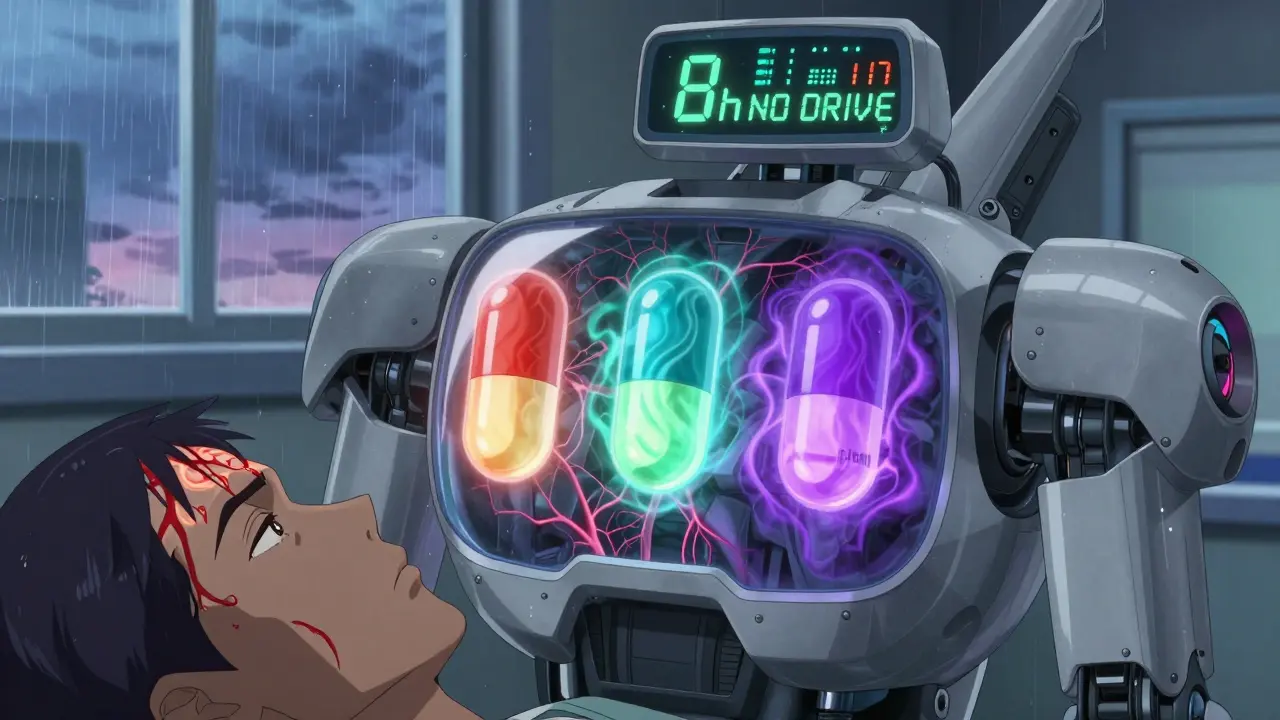
That’s why the FDA requires a warning: don’t drive or operate machinery for at least 8 hours after taking it. Most people can’t go back to work, school, or even care for kids after a dose. That’s a huge downside if you need to function quickly.
Nausea and fatigue are also common. Muscle weakness? Reported in 2.8% of users. Palpitations? 1.7%. And while there’s no proven link yet, experts caution against using it if you have a history of seizures or take meds that lower your seizure threshold.
With an average rating of 5.8/10 on Drugs.com and 63% of negative reviews citing sedation, it’s clear: ditans aren’t first-line for most. They’re a backup - for people who can’t take triptans and can’t wait hours for a gepant to work.
Comparing Safety: The Numbers Don’t Lie
A 2021 analysis of 64 trials involving over 46,000 people gives us the clearest picture yet. Here’s how the classes stack up on risk of any side effect compared to placebo:
- Ditans (lasmiditan): 2.87 times higher risk
- Triptans: 1.5 times higher risk
- Gepants: 1.1 times higher risk
That means ditans are nearly three times more likely to cause side effects than placebo. Triptans are about half as risky as ditans. Gepants? Almost the same as placebo.
When comparing directly, triptans were more likely to cause side effects than both ubrogepant and rimegepant. The difference isn’t huge - but it’s consistent. And for people who’ve had bad reactions to triptans, that’s enough to switch.
Who Should Use What?
There’s no one-size-fits-all. But here’s how to think about it:
- Choose triptans if: You need fast relief, have no heart issues, and tolerate side effects like chest tightness or dizziness. Almotriptan and frovatriptan tend to be gentler than others.
- Choose gepants if: You have heart disease, high blood pressure, or had bad reactions to triptans. You’re okay waiting an hour or two. You want to avoid sedation and can use it for prevention too.
- Choose ditans only if: You can’t use triptans or gepants, and you’re okay being out of commission for 8+ hours. Use it as a last resort - not a daily option.
Also, watch for drug interactions. Rimegepant shouldn’t be taken with strong CYP3A4 inhibitors like ketoconazole - it can build up in your system. Triptans shouldn’t be mixed with dihydroergotamine within 24 hours. And never mix ditans with alcohol or sedatives.

Real People, Real Experiences
Online reviews tell a story that clinical trials can’t fully capture. On Drugs.com, triptans average 6.4/10. Half of users say they work. The other half say the side effects aren’t worth it. "Severe chest pressure with first dose of Imitrex - never using it again," one user wrote.
Gepants are climbing. Nurtec’s 7.1/10 rating comes from people who value safety over speed. "I can finally take something without feeling like I’m going to pass out," said another.
Lasmiditan? 5.8/10. The complaints are almost all about the same thing: "I felt like I was drunk. Couldn’t drive. Couldn’t work. Had to call in sick."
Reddit’s r/Migraine community had 78 posts about triptan side effects in November 2023. Only 31 mentioned lasmiditan - but nearly every one described sedation. The pattern is clear: people are leaving triptans for gepants, and ditching ditans because they’re too disabling.
What’s Next?
There’s new hope on the horizon. Zavegepant, an intranasal gepant, just finished Phase 3 trials with a side effect rate of just 12.3% - lower than placebo. It works in under 30 minutes and doesn’t affect blood vessels. If approved, it could be the best of both worlds: fast, safe, and non-oral.
Long-term safety data is still limited. Rimegepant has two years of data showing it’s safe for regular use. Other gepants? Not yet. But the trend is unmistakable: safer alternatives are winning.
Doctors still prescribe triptans because they’re cheap, effective, and familiar. But for many patients, the risks outweigh the benefits. The future of migraine care isn’t about stronger drugs. It’s about smarter ones - ones that stop pain without stopping your life.
Are triptans safe if I have high blood pressure?
No. Triptans cause blood vessels to narrow, which can be dangerous if you have uncontrolled high blood pressure, heart disease, or a history of stroke. Guidelines from the American Academy of Family Physicians recommend avoiding triptans in these cases. If you have cardiovascular risk factors, talk to your doctor about gepants instead.
Can I drive after taking a ditan like Reyvow?
No. The FDA requires a black box warning for lasmiditan (Reyvow): you must not drive or operate machinery for at least 8 hours after taking it. Clinical studies show significant impairment in coordination, reaction time, and alertness. Many users report feeling "drunk without alcohol." If you need to function after treatment, ditans are not a good choice.
Which migraine medication has the fewest side effects?
Gepants - specifically ubrogepant and rimegepant - have the lowest rate of side effects among all three classes. Nausea affects only 4-6% of users, drowsiness around 2-4%, and there’s no risk of vasoconstriction or sedation. In head-to-head trials, gepants caused fewer side effects than triptans and far fewer than ditans. They’re the safest option for most people, especially those with heart conditions.
Why do some people say triptans make them feel worse?
Triptans can cause sensations like chest tightness, tingling, flushing, and dizziness - which mimic migraine symptoms. Many patients mistake these for side effects, but they’re often just the migraine itself. Still, for some, the physical discomfort is too much. If you feel worse after taking a triptan, it might be the drug - or it might be the migraine. A doctor can help tell the difference.
Is there a migraine drug that works fast and is safe for the heart?
Yes - zavegepant, an intranasal gepant, just completed Phase 3 trials with promising results. It works in under 30 minutes, doesn’t affect blood vessels, and has a low side effect rate. While not yet approved as of early 2026, it’s likely to become a top option soon. Until then, rimegepant (Nurtec ODT) is the closest thing: safe for the heart and effective, though it takes 1-2 hours to work.
John Ross
January 4, 2026 AT 12:10Triptans are basically vasoconstrictors with a side of placebo effect. CGRP antagonism is the future - gepants don't trigger endothelial dysfunction or platelet aggregation. If you're prescribing sumatriptan to someone with metabolic syndrome, you're not a doctor, you're a liability.
jigisha Patel
January 5, 2026 AT 11:25Based on the 2021 meta-analysis of 64 trials involving 46,000 subjects, the relative risk of adverse events for ditans versus placebo was 2.87 (95% CI: 2.41–3.42), while for triptans it was 1.50 (95% CI: 1.38–1.63), and for gepants, 1.10 (95% CI: 0.99–1.22). The p-values for gepant-placebo comparisons were non-significant across all endpoints. This is not anecdotal - this is evidence-based pharmacology.
Jack Wernet
January 5, 2026 AT 21:41I’ve been on both triptans and rimegepant. The chest tightness from triptans scared me more than the migraine itself. I didn’t realize until I switched that I’d been mistaking drug side effects for aura symptoms. Gepants didn’t just work - they gave me back my life. No dizziness. No panic. Just relief.
Charlotte N
January 6, 2026 AT 20:31so like... if i have high bp but no heart disease... is it totally off limits or just risky... i mean like... what if i take it with a beta blocker... does that help... or make it worse... idk
Catherine HARDY
January 8, 2026 AT 06:05Have you noticed how all the "safe" drugs are made by Big Pharma? Gepants cost $900 a pill. Triptans are $5. The FDA loves these new expensive drugs because they get kickbacks from the labs. They don't care if you can afford it - they just want you hooked on the latest branded nonsense. They’re hiding the truth: triptans work fine if you're healthy. They just don't want you to know that.
bob bob
January 8, 2026 AT 12:27Man, I used to crush triptans like candy. Then I got hit with that chest pressure and thought I was dying. Switched to Nurtec - took a little longer, but I didn’t feel like I’d been hit by a truck. Now I take it every other day for prevention too. Best decision I ever made. Your body isn’t broken - you just need the right tool.
Vicki Yuan
January 8, 2026 AT 23:10It's critical to distinguish between pharmacodynamic safety and pharmacokinetic tolerability. Gepants exhibit minimal off-target binding, whereas triptans have high affinity for 5-HT1B/1D receptors, which mediate vasoconstriction. Ditans bind selectively to 5-HT1F, avoiding vascular effects entirely - but their CNS penetration causes dose-dependent sedation. Therefore, risk-benefit analysis must be individualized, not categorical.
Aaron Mercado
January 9, 2026 AT 04:48TRIPTANS ARE KILLING PEOPLE AND NO ONE IS TALKING ABOUT IT!! I KNOW A GUY WHO HAD A MINI-STROKE AFTER A SUMATRIPTAN!! THEY’RE HIDING THIS!! THE FDA IS IN BED WITH PHARMA!! YOU THINK THEY WANT YOU TO KNOW THAT A $5 PILLS COULD KILL YOU?? THEY WANT YOU DEPENDENT ON $1000 MONTHLY MEDS!!
saurabh singh
January 11, 2026 AT 03:15bro, i tried triptans, felt like my heart was gonna explode. then i tried nurtec - yeah, took 90 mins, but i could still play with my kid, check emails, no brain fog. now i tell all my migraine buddies: skip the drama, go for the quiet win.
Mandy Kowitz
January 11, 2026 AT 08:27So let me get this straight - we’re replacing a $5 drug that works in 30 minutes with a $1000 drug that works in 90 minutes… and calling it progress? Cool. I’ll just keep my headache and my bank account.
Michael Rudge
January 11, 2026 AT 23:53It’s amusing how people treat gepants like some miracle cure. They’re not. They’re just less toxic than triptans - which, granted, isn’t hard. But they’re still expensive, slow, and not covered by half the insurance plans. You’re not saving your life - you’re just avoiding a slightly less bad version of hell.
Doreen Pachificus
January 12, 2026 AT 17:16Just read this whole thing. I’ve been on everything. Triptans made me feel weird. Gepants made me feel… normal. Ditans made me feel like I’d been drugged. Honestly? Gepants are the quiet MVP. No drama. No panic. Just… relief.
Enrique González
January 13, 2026 AT 19:08My neurologist told me to try Reyvow after triptans failed. I took it at 3 PM. By 5 PM I was on the couch, unable to speak clearly. Couldn’t answer my kid’s question about his homework. I cried. I didn’t know why. That’s not treatment. That’s chemical sedation with a fancy name.
Dee Humprey
January 15, 2026 AT 07:05You’re not alone. I used to feel like I was failing because I couldn’t handle triptans. Then I found rimegepant. It’s not glamorous. It doesn’t make you feel like a superhero. But it lets you be human again. 💙
Vikram Sujay
January 16, 2026 AT 01:10The evolution of migraine therapeutics reflects a broader paradigm shift in neurology: from vasoconstrictive palliation toward neuromodulatory homeostasis. The pharmacological targeting of CGRP represents not merely an incremental advance, but a fundamental reorientation of therapeutic intent - from suppression of symptomatology to restoration of neural equilibrium. This paradigm, though economically constrained by patent monopolies, constitutes the most ethically coherent framework for chronic neurological care yet devised.