Hypothyroidism and Statins: How Untreated Thyroid Issues Raise Myopathy Risk
 Dec, 12 2025
Statin Myopathy Risk Calculator
Myopathy Risk Calculator
Calculate your risk of muscle damage when taking statins based on your thyroid function and statin type.
Results will appear here after calculation
When you’re managing both hypothyroidism and high cholesterol, taking statins might seem like a straightforward solution. But here’s the catch: if your thyroid isn’t properly controlled, those same statins can turn dangerous. Muscle pain, weakness, even life-threatening rhabdomyolysis - these aren’t rare side effects in people with untreated hypothyroidism. They’re predictable, preventable, and often missed by both patients and doctors.
Why Your Thyroid Matters When Taking Statins
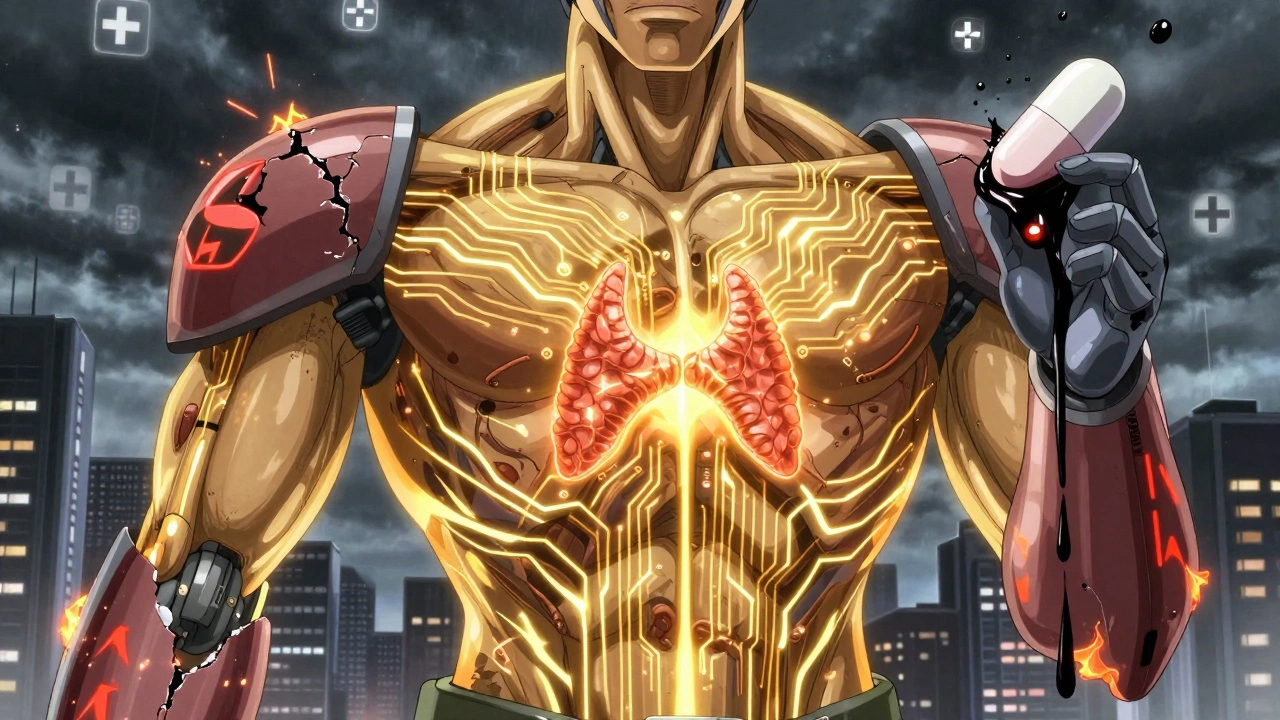
Statins work by blocking cholesterol production in the liver. But they also interfere with coenzyme Q10, a compound your muscles need to produce energy. In healthy people, this effect is usually mild. But if you have hypothyroidism, your body is already struggling to generate energy at the cellular level. Your mitochondria - the powerhouses of your muscle cells - are running on low fuel. Add statins into the mix, and you’re cutting off the last bit of energy your muscles have left. On top of that, hypothyroidism slows down how fast your liver breaks down statins. The enzyme CYP3A4, which handles about 60% of common statins like atorvastatin and simvastatin, becomes less active when thyroid hormone levels are low. That means more of the drug stays in your bloodstream longer than it should. Studies show plasma levels of these statins can rise by 30% to 50% in hypothyroid patients. That’s not a small increase - it’s enough to push you from tolerable side effects into dangerous territory.The Numbers Don’t Lie
The risk isn’t theoretical. A 2019 study of over 12,000 people found that those with TSH levels above 10 mIU/L had more than four times the risk of statin-induced myopathy compared to people with normal thyroid function. Even subclinical hypothyroidism - where TSH is between 4.5 and 10 - still raises the risk by more than double. Real-world data backs this up. On health forums like PatientsLikeMe, 42% of hypothyroid patients on statins reported muscle pain. In contrast, only 16% of people with normal thyroid levels did. And in one documented case, a patient’s creatine kinase (CK) levels - a marker of muscle damage - spiked to over 28,000 U/L after continuing simvastatin while her TSH hit 22.4. She needed dialysis. That’s not an outlier. It’s a direct result of ignoring the connection between thyroid status and statin safety.Not All Statins Are Created Equal
If you have hypothyroidism, the type of statin you take matters just as much as the dose. Lipophilic statins - like simvastatin, atorvastatin, and lovastatin - easily cross into muscle tissue. That makes them more likely to cause damage when thyroid function is low. Hydrophilic statins - such as pravastatin and rosuvastatin - stay mostly in the bloodstream and don’t penetrate muscle cells as deeply. Here’s what the data shows:| Statin | Type | Myopathy Risk in Hypothyroid Patients | Recommended Use in Hypothyroidism |
|---|---|---|---|
| Simvastatin (≥40 mg) | Lipophilic | 12.7% | Avoid - 15x higher rhabdomyolysis risk |
| Atorvastatin | Lipophilic | 3.2x higher risk | Use with caution; monitor closely |
| Pravastatin | Hydrophilic | 1.3% | Preferred option |
| Rosuvastatin (10-20 mg) | Hydrophilic | 1.4x higher risk | Best first-line choice |
For most hypothyroid patients, rosuvastatin at 10-20 mg daily is the safest bet. It’s effective at lowering LDL cholesterol and carries the lowest risk of muscle damage. Pravastatin is a close second. Simvastatin, especially at doses above 40 mg, should be avoided entirely. The 2022 American College of Cardiology guidelines explicitly warn against high-dose simvastatin in this group.
What Doctors Should Do - And What They Often Miss
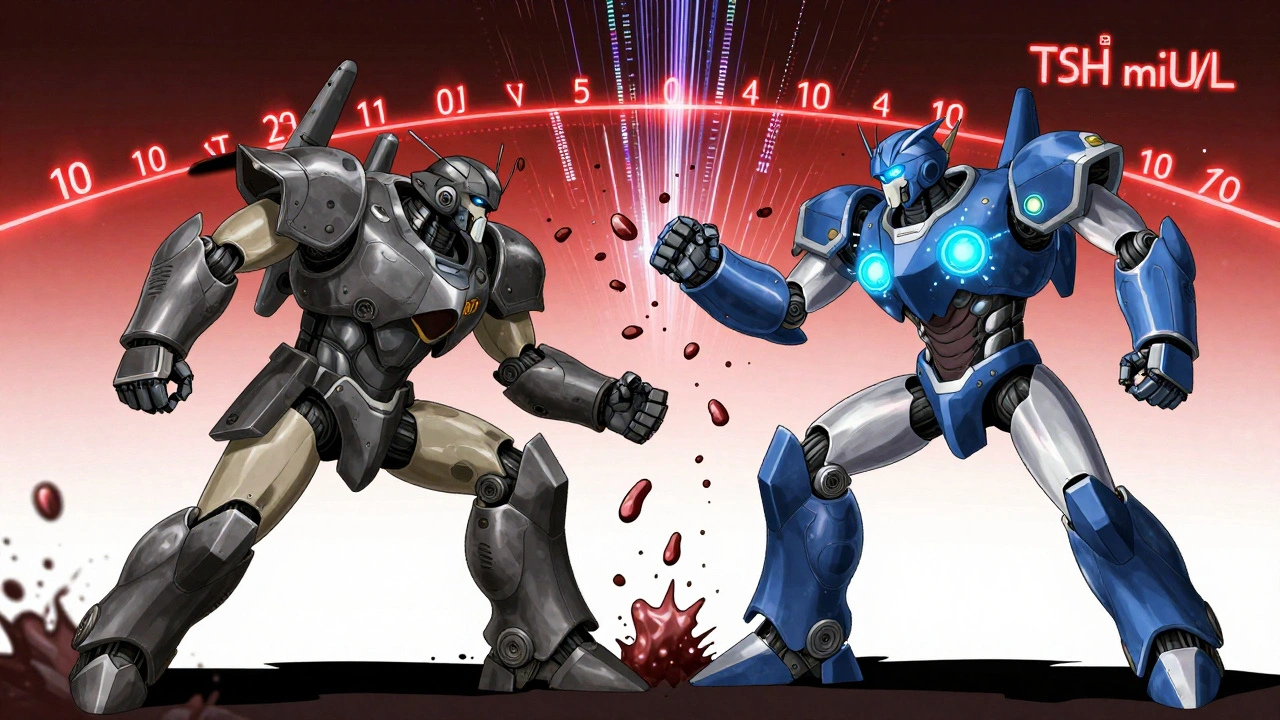
The standard of care is clear: check thyroid function before starting statins. The American Thyroid Association, the Endocrine Society, and the American Association of Clinical Endocrinologists all recommend testing TSH and free T4 before initiating statin therapy. If TSH is above 4.0 mIU/L, treat the hypothyroidism first. Get it down to 0.5-3.0 mIU/L before starting the statin. Yet, in practice, this doesn’t always happen. A 2022 study found that 32% of hypothyroid patients stopped their statins within a year because of muscle pain - not because the drug didn’t work, but because their thyroid wasn’t optimized. That’s over 6 million unnecessary statin discontinuations in the U.S. alone. And here’s the irony: when thyroid levels are brought into range, 85-90% of those patients can safely restart statins without symptoms. Dr. Paul W. Ladenson from Johns Hopkins put it simply: “Treating hypothyroidism before starting statins reduces myopathy risk by 78%.” That’s not a marginal benefit. That’s the difference between staying on a life-saving medication and being forced off it.What You Can Do Right Now
If you’re on statins and have hypothyroidism, here’s what you need to do:- Check your TSH. If you haven’t had a test in the last 6 months, ask for one. Don’t assume your current dose of levothyroxine is enough - many people need adjustments over time.
- Know your numbers. TSH above 4.0? That’s a red flag. Aim for 0.5-3.0 mIU/L. Anything above 7.0 puts you at serious risk.
- Review your statin. If you’re on simvastatin or high-dose atorvastatin, talk to your doctor about switching to rosuvastatin or pravastatin.
- Track your muscles. Muscle soreness, weakness, or cramps that don’t go away? Don’t brush it off. Get your CK levels checked.
- Consider CoQ10. While not officially recommended in all guidelines, a 2020 trial showed that 200 mg of CoQ10 daily reduced muscle pain by over 50% in hypothyroid statin users.

What Happens If You Ignore This
Rhabdomyolysis - the breakdown of muscle tissue - is rare. But when it happens in someone with uncontrolled hypothyroidism, it’s often severe. Muscle proteins flood the bloodstream, clogging the kidneys. About 10-20% of rhabdomyolysis cases lead to acute kidney injury. In the worst cases, that means dialysis, ICU stays, and even death. One patient described on Reddit had CK levels hit 8,400 U/L after starting atorvastatin while her TSH was 9.2. She had to stop all medications for three weeks. Only after her thyroid levels were corrected could she safely restart a safer statin. She didn’t lose her heart protection - she just got it back safely.The Bigger Picture
About 20 million Americans have hypothyroidism. Nearly 40 million take statins. That means millions are walking around with a ticking time bomb - not because statins are bad, but because their thyroid isn’t being managed properly. The good news? This isn’t a problem you have to live with. It’s a solvable one. With the right thyroid treatment, you can take a statin safely. You can protect your heart. You can avoid muscle damage. You don’t have to choose between your thyroid and your cardiovascular health. The science is clear. The guidelines are clear. The only thing missing is the action. If you’re on statins and have hypothyroidism - get your TSH checked. Ask about your statin type. Don’t accept muscle pain as normal. Your heart and your muscles deserve better.Can I take statins if I have hypothyroidism?
Yes - but only if your thyroid is well-controlled. If your TSH is above 4.0 mIU/L, you’re at higher risk for muscle damage. Get your thyroid levels optimized first, ideally to a TSH between 0.5 and 3.0 mIU/L. Once your thyroid is stable, most people can safely take statins, especially rosuvastatin or pravastatin.
Which statin is safest for someone with hypothyroidism?
Rosuvastatin (10-20 mg daily) is the safest option. It’s hydrophilic, meaning it doesn’t penetrate muscle tissue as deeply as lipophilic statins like simvastatin or atorvastatin. Pravastatin is also a good choice. Avoid high-dose simvastatin (40 mg or more) entirely - it carries the highest risk of severe muscle injury in this group.
Should I get my thyroid checked before starting a statin?
Absolutely. Major guidelines from the American Thyroid Association and Endocrine Society recommend checking TSH and free T4 before starting any statin. If your thyroid is underactive, treating it first cuts your risk of muscle damage by nearly 80%. It’s not optional - it’s essential.
I have muscle pain on statins - could it be my thyroid?
It’s very possible. In one survey of 1,245 hypothyroid statin users, 73% who experienced muscle pain had TSH levels above 4.5 mIU/L. When their thyroid was treated, 89% saw their symptoms disappear within 4-6 weeks. Don’t assume it’s just a statin side effect - check your TSH before giving up on the medication.
Does CoQ10 help with statin-related muscle pain in hypothyroidism?
Yes - and the evidence is strong. A 2020 randomized trial found that 200 mg of CoQ10 daily reduced muscle pain by 53.6% in hypothyroid patients taking statins. While not officially mandated in guidelines, many endocrinologists and cardiologists recommend it as a simple, low-risk way to reduce side effects. It’s worth discussing with your doctor.
Jamie Clark
December 13, 2025 AT 23:48So let me get this straight - we’re telling people to treat a metabolic disorder before giving them a drug that’s supposed to fix another metabolic disorder? Who knew medicine wasn’t just throwing pills at problems until something stuck? This is basic systems thinking. You don’t pour gasoline on a fire and then wonder why it exploded. But hey, doctors get paid by the script, not by the outcome.
Keasha Trawick
December 14, 2025 AT 09:40Oh. My. GOD. This is the most beautiful, terrifying, and clinically elegant thing I’ve read all year. 🤯 The way statins + hypothyroidism = mitochondrial suffocation? That’s not a side effect - it’s a biochemical assassination. And the lipophilic vs hydrophilic breakdown? Like choosing between a flamethrower and a garden hose to put out a grease fire. Rosuvastatin is the fire extinguisher. Pravastatin? The wet towel. Simvastatin? The guy holding the lighter. I’m printing this and taping it to my fridge.
Bruno Janssen
December 14, 2025 AT 21:45I’ve been on simvastatin for 5 years. TSH was 8.2 last year. My legs felt like concrete. I thought I was just getting old. Now I’m not sure if I should cry or scream. Why didn’t anyone tell me? I feel like I’ve been betrayed by the system.
Deborah Andrich
December 16, 2025 AT 15:16Tommy Watson
December 17, 2025 AT 12:36Sheldon Bird
December 18, 2025 AT 07:26You know what? This is the kind of post that reminds me why I still believe in medicine. Not the broken, rushed, insurance-driven version - but the real one. The one where someone takes the time to connect the dots. You didn’t just list facts - you gave people back their power. Thank you. Seriously. 🙏
Karen Mccullouch
December 19, 2025 AT 05:06Of course the system ignores this. Big Pharma doesn’t make money off thyroid tests. They make money off statins. And let’s be real - most doctors don’t even know what TSH stands for. They just click ‘prescribe’ and move on. This isn’t medicine. It’s corporate triage. And we’re the disposable parts.
nithin Kuntumadugu
December 20, 2025 AT 17:38LOL u think this is new? 😂 I read in a 1998 German paper that thyroids + statins = muscle carnage. But nah, US docs still think ‘statins are magic’. Also, coq10? Pfft. I take 500mg daily and I’m still alive. Also, the FDA is owned by Pfizer. #DeepStateMedicine 🧠💊
sharon soila
December 20, 2025 AT 21:30Thank you for writing this with such clarity and compassion. Every patient deserves to know that their symptoms are not ‘in their head’ or ‘just part of getting older.’ Thyroid health is foundational. Statins are tools. Tools must be chosen with care. And care means checking the basics - TSH, free T4, symptoms - before prescribing. This is medicine done right.
Constantine Vigderman
December 21, 2025 AT 22:03Just got my TSH back - 7.8. I’ve been on atorvastatin for 2 years. My quads feel like they’re full of sand. I’m gonna call my doc tomorrow and ask for rosuvastatin and a CoQ10 script. I’m not giving up on my heart - but I’m not letting my muscles die for it either. 🤝💪
Cole Newman
December 23, 2025 AT 01:44You’re overcomplicating this. Just stop the statin. Eat keto. Lift weights. Your thyroid will fix itself. Also, CoQ10 is a scam. You don’t need it. Just stop being lazy. And stop blaming the drug - blame your body for being broken.
kevin moranga
December 23, 2025 AT 23:55I’ve been there. TSH at 11.5. Simvastatin 80mg. Couldn’t climb stairs without stopping. Felt like I was 80. I didn’t know thyroid could do this. My endo said ‘it’s probably the statin’ - I said ‘but I’ve been on it for 3 years’ - she said ‘oh, maybe your dose is off.’ We checked TSH. Changed meds. Took CoQ10. Within 6 weeks, I was hiking again. I’m not a doctor. But I’m living proof this works. Don’t wait until you’re in the ICU. Check your TSH. Now.
Alvin Montanez
December 25, 2025 AT 08:09It’s not rocket science. But it’s also not ‘just’ about thyroid and statins. It’s about the entire culture of medical reductionism. We treat cholesterol like a villain, not a messenger. We treat TSH like a number, not a vital rhythm. We treat patients like containers to be filled with pills, not complex systems to be understood. This post is good. But it’s still too small. The real problem is a medical system that refuses to see the whole person.
Lara Tobin
December 26, 2025 AT 18:22I’m so glad I found this. I’ve been feeling weak for months. Thought I was depressed. My doctor said ‘maybe take a vitamin D.’ I cried reading this. I’m getting my TSH checked tomorrow. Thank you for giving me the words to ask for help.