How to Read Interaction Warnings on Medication Guides
 Jan, 15 2026
Every year, thousands of people end up in the hospital because they didn’t realize their pills could clash. It’s not always obvious-some interactions happen between your blood pressure pill and that over-the-counter cold medicine. Others sneak in through herbal supplements or even grapefruit juice. The good news? Medication guides are designed to warn you. The problem? Most people read them like instructions for assembling furniture: quickly, half-awake, and then forget them.
What You’re Actually Looking At
Medication guides aren’t just small papers tucked into your pill bottle. They’re legally required safety documents approved by the U.S. Food and Drug Administration (FDA). If you’re taking a prescription drug with serious interaction risks-like blood thinners, antidepressants, or cholesterol meds-you’ll get one. These guides follow strict formatting rules. The FDA requires them to use plain language, avoid jargon, and highlight the most dangerous warnings in bold or black boxes.Look for three key sections:
- Warnings: This is where absolute no-go zones live. If it says “Do not take if…” in bold, that’s not a suggestion. It’s a red line.
- Drug Interactions: This section lists specific drugs, supplements, or foods that can cause harm when taken together. It doesn’t just say “avoid grapefruit.” It tells you why and what happens.
- How Supplied: This sounds boring, but it matters. Some drugs break down if stored near heat or light. If your interaction warning mentions instability, this section helps you avoid accidental exposure.
For example, the guide for warfarin (a blood thinner) doesn’t just say “avoid NSAIDs.” It warns that combining it with ibuprofen or naproxen increases your risk of serious bleeding by 70-100%. That’s not a small bump-it’s a dangerous spike. And it’s not just about other pills. The guide also flags foods like cranberry juice and green leafy vegetables, which can throw off your INR levels.
Understanding the Severity Levels
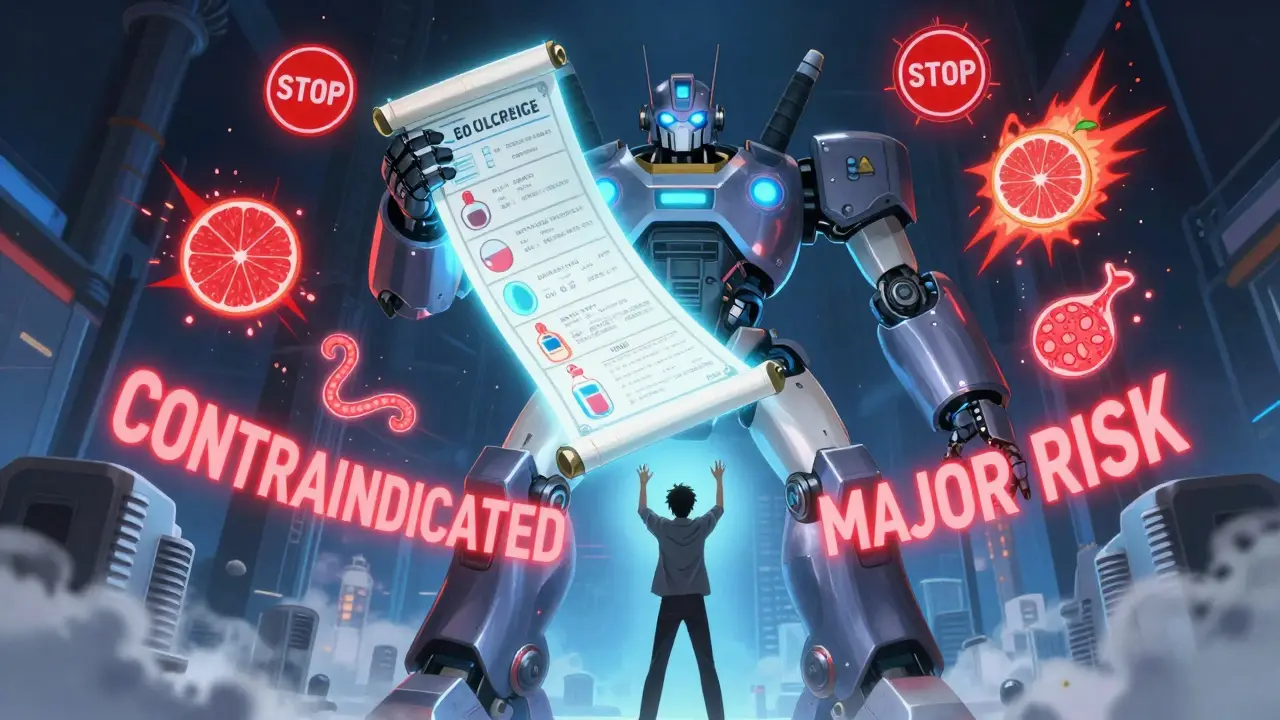
Not all warnings are created equal. Medication guides use clear language to tell you how serious a risk is:- Contraindicated: Do not take together. Period. This is a hard stop. Examples: taking simvastatin with clarithromycin (an antibiotic) can cause muscle breakdown so severe it leads to kidney failure.
- Major: Can cause serious harm. You might still take both, but only under close supervision. Example: mixing sertraline (an antidepressant) with tramadol (a painkiller) can trigger serotonin syndrome-a life-threatening surge in brain chemicals.
- Moderate: Monitor closely. You can take them together, but your doctor may need to adjust doses or run blood tests. Example: taking lisinopril (blood pressure) with potassium supplements can raise potassium to unsafe levels.
- Minor: Low risk. Usually just a mild effect, like slightly reduced absorption. Still worth noting, but not urgent.
These categories aren’t random. They’re based on real clinical data. A 2021 study in the Annals of Pharmacotherapy showed that 60% of moderate interactions can be avoided just by spacing doses 2-4 hours apart. That’s something you can do right now-no doctor visit needed.

What People Miss (And Why It’s Dangerous)
Most patients focus only on their prescription drugs. That’s the biggest mistake.The FDA’s Adverse Event Reporting System found that 37% of serious drug interactions involve over-the-counter meds or supplements. Think about it: you might be taking a daily aspirin for heart health, a melatonin for sleep, and a turmeric capsule for joint pain. None of those seem like big deals. But together? They can thin your blood, interfere with liver enzymes, or boost the effect of your prescription drugs.
Here’s a real example: a patient in Melbourne was taking apixaban (a blood thinner) for atrial fibrillation. She also took St. John’s wort for mild depression. The interaction wasn’t listed as “contraindicated,” but the guide did say “may reduce effectiveness.” She didn’t think it mattered-until she had a stroke. St. John’s wort speeds up how fast your body breaks down apixaban. Her dose became useless. That’s why the guide says “Use with Caution”-not because it’s harmless, but because the risk is hidden.
And then there’s food. Grapefruit is the classic villain, but it’s not alone. Seville oranges, pomelos, and even some types of apple juice can interfere with how your body processes statins, calcium blockers, and immunosuppressants. The simvastatin guide warns that one glass of grapefruit juice can increase drug levels by 10 times. That’s not a myth-it’s a measurable spike in blood concentration that can lead to muscle damage.
How to Actually Use the Guide
Reading the guide isn’t enough. You need to act on it. Here’s a simple four-step process that works:- List everything you take. Not just pills. Include vitamins, herbal teas, CBD oil, and even eye drops. Write down the dose and how often you take it. Most people take 4-5 medications daily, according to the Agency for Healthcare Research and Quality. You might be surprised.
- Find the interaction section in each guide. Don’t skip the OTC ones. Flip through the box for your ibuprofen or allergy pill. Look for the “Drug Interactions” or “Warnings” section. Use a highlighter if it helps.
- Check for red flags. Look for words like “avoid,” “do not take,” “increase risk,” or “monitor.” If you see any, pause. Don’t assume it’s okay because you’ve taken it before.
- Ask your pharmacist. They’re not just the person who hands you the bottle. They’re trained to spot hidden risks. Bring your list. Show them the guides. Ask: “Are any of these dangerous together?”
One patient I know started photographing every medication guide on her phone. She kept them in a folder labeled “My Meds.” When she went to the doctor, she’d pull it up. No more guessing. No more forgetting. She avoided two potential hospitalizations in 18 months just by doing that.
What’s Changing (And Why It Matters)
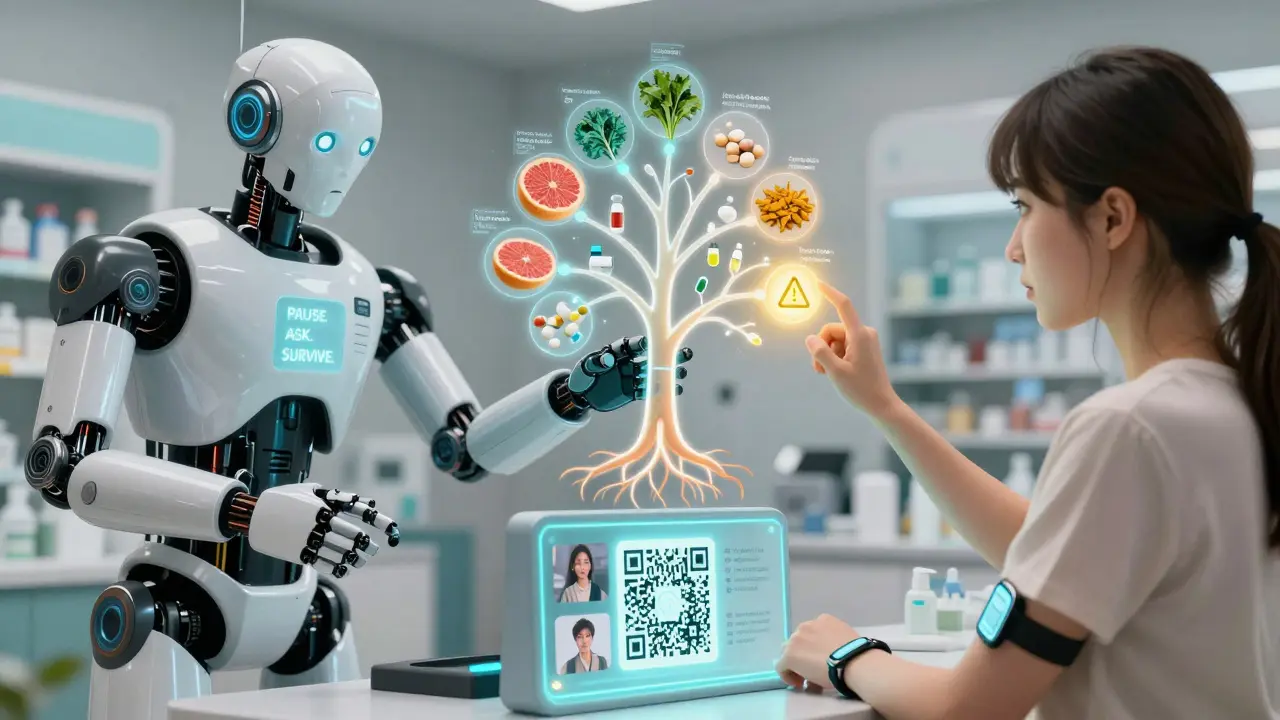
The system is getting better. Since 2023, the FDA has required new drug applications to include QR codes that link to digital versions of medication guides. These aren’t just PDFs-they’re interactive. You can click on a warning and get a video explanation, hear it read aloud, or even see a chart showing how the interaction affects your body.By 2025, all new medication guides must use standardized language: Contraindicated, Avoid, Use with Caution. No more vague phrases like “may interact.” That’s huge. A 2023 study in the Journal of the American Medical Informatics Association showed that when warnings were made clearer, patient understanding jumped from 58% to 82%.
Even better? Hospitals and pharmacies are starting to use electronic health records to flag interactions automatically. If you’re on a new drug, your doctor’s system might pop up a warning before the prescription even prints. That’s not magic-it’s data. And it’s becoming standard.
When in Doubt, Pause
You don’t need to be a pharmacist to stay safe. You just need to be careful. If a warning makes you uneasy, don’t ignore it. Don’t assume it’s fine because “it’s just a supplement.” Don’t wait until you feel sick to act.Medication guides exist because people have died from things that could’ve been avoided. The FDA says drug interactions cause 6-7% of all adverse drug events. That’s not a small number. It’s 7,000 deaths a year in the U.S. alone.
Take five minutes. Read the guide. Ask the question. Keep a list. Use the QR code. Your body will thank you.
What should I do if I see a drug interaction warning I don’t understand?
Don’t guess. Call your pharmacist or doctor. Ask them to explain the warning in simple terms. You can also look up the drug name and “interaction warning” on the FDA’s website or use a trusted drug interaction checker like the one from Micromedex or Lexicomp. Never rely on random internet searches-they’re often outdated or misleading.
Are over-the-counter medications really dangerous with prescriptions?
Yes. Many people think OTC means “safe,” but that’s not true. Common painkillers like ibuprofen and naproxen can increase bleeding risk with blood thinners. Antihistamines like diphenhydramine can worsen confusion in older adults on dementia meds. Even vitamin E and fish oil can thin your blood. The FDA reports that 37% of serious interactions involve OTC drugs or supplements.
Can I still take my supplements if I’m on prescription drugs?
Some are fine, some aren’t. It depends on the drug. For example, St. John’s wort can make birth control, antidepressants, and blood thinners less effective. Magnesium can interfere with antibiotics like tetracycline. Always check the interaction section of your medication guide and ask your pharmacist before starting any new supplement.
Why does my guide say to avoid grapefruit but not mention orange juice?
Not all citrus is the same. Only Seville oranges, pomelos, and grapefruit contain furanocoumarins-the compounds that block the enzyme (CYP3A4) that breaks down many drugs. Regular sweet oranges and most apple juices don’t have this effect. But if your guide says “avoid grapefruit,” don’t assume other citrus is safe unless it’s specifically cleared. When in doubt, ask.
Is it safe to take my meds with food?
Some drugs work better with food, others don’t. For example, antibiotics like tetracycline should be taken on an empty stomach because dairy blocks absorption. But statins like atorvastatin are often taken with dinner because food helps your body absorb them. Always check the guide. If it says “take on an empty stomach,” wait at least an hour before eating. If it says “take with food,” have a light snack.
What if I accidentally took a drug that interacts with my prescription?
Don’t panic. But don’t wait. Call your pharmacist or doctor immediately. If you’re taking a blood thinner and accidentally took ibuprofen, they may want to check your INR level. If you mixed an antidepressant with a painkiller and feel dizzy, nauseous, or confused, seek medical help right away. Most interactions don’t cause instant harm, but some can escalate quickly. Better safe than sorry.
Bobbi-Marie Nova
January 16, 2026 AT 01:44Okay but can we talk about how the FDA makes these guides look like they were designed by a sleep-deprived intern who hates humanity? I read mine last week and it felt like a ransom note written in Comic Sans. Still, I printed it out, laminated it, and taped it to my fridge next to my grocery list. My cat now stares at it like it’s a sacred text. 🤷♀️
Nicholas Gabriel
January 18, 2026 AT 01:15Thank you for this. Seriously. I used to skip these guides like they were junk mail-until my mom ended up in the ER because she took St. John’s Wort with her SSRI. She didn’t even know it was a problem. Now I keep a binder. Every pill. Every supplement. Every tea. I even color-code them: red for 'DO NOT TOUCH,' yellow for 'watch out,' green for 'probably fine.' My pharmacist calls me 'The Spreadsheet Queen.' I wear it as a badge.
And yes-QR codes are a game-changer. I scanned my warfarin guide last month and it played a 90-second video of a nurse explaining INR levels with a cartoon blood cell. I cried. Not because it was sad-because for the first time, I felt like someone actually cared enough to make it understandable.
kanchan tiwari
January 19, 2026 AT 13:21THEY’RE LYING TO US. I KNOW IT. The FDA doesn’t want you to know that grapefruit juice isn’t the real villain-it’s the pharmaceutical companies who profit when you get sick from their drugs. They put the warning in tiny print so you’ll keep buying. And don’t get me started on the 'Use with Caution' label-that’s just corporate speak for 'we know this will kill you, but we’re not sued yet.' I’ve started a petition. 12,000 signatures. They’re scared. They’re hiding something.
Also, my neighbor’s dog died after eating a pill he dropped. Coincidence? I think not.
Cheryl Griffith
January 21, 2026 AT 11:38I used to think I was fine just reading the bold parts. Then I realized I’d been ignoring the 'Drug Interactions' section entirely because it looked like a phone book. Now I read it aloud while making tea. It forces me to slow down. Last month, I caught that my magnesium supplement was canceling out my antibiotic-just by reading the fine print. I didn’t even know I was taking both at the same time. My doctor said I saved myself from a full-blown infection. Small habits, huge results.
swarnima singh
January 23, 2026 AT 11:36why do we even trust these guides?? the system is broken. they sell us pills then scare us with the side effects like its our fault for not reading the 47 page manual. i take my meds and i take my turmeric and i take my chamomile tea and i dont want to live in fear. life is short. if i die early at least i died happy. the pharma giants dont care about you. they care about your insurance number.
Isabella Reid
January 24, 2026 AT 13:43I’m from India and I’ve seen this play out in my family-grandma taking ayurvedic herbs with her blood pressure meds, no one saying a word. I started translating the medication guides into Hindi and sharing them on WhatsApp groups. One aunt sent me a photo of her handwritten notes next to her pill bottle. That’s the moment I realized: information isn’t power unless it’s accessible. Simple. Human. Shared.
Jody Fahrenkrug
January 26, 2026 AT 09:16My mom used to say, 'If it’s not on the label, it’s not a problem.' Then she took melatonin with her blood thinner and ended up in the ER. Now I keep a little notepad in my purse. Every time I pick up a new prescription, I write down the guide’s three most important warnings. It takes 30 seconds. It saves lives. Even mine.
Kasey Summerer
January 28, 2026 AT 07:21guy who wrote this is a legend. 🙌 i scanned my simvastatin guide and it played a voiceover in my grandma’s accent. i cried. not because i was moved-because i realized i’d been taking it with grapefruit juice for 3 years. my liver is probably mad at me. but hey, at least now i know. thanks for the QR code tip. i’m scanning everything now. even my ibuprofen. 😅
john Mccoskey
January 29, 2026 AT 20:04Let’s be honest: this entire system is a farce. The FDA doesn’t care about you. They care about liability. The 'contraindicated' warnings? They’re only there because someone died and the company got sued. The 'major' ones? Those are the ones where the drug company can still make money if you’re monitored closely. The 'moderate'? That’s where the real carnage happens-because you think you’re safe, so you keep taking it. And then you’re the one who ends up with rhabdomyolysis or liver failure. The guides are designed to make you feel informed, not safe. The real safety net? A pharmacist who actually listens. And those are rarer than honest politicians.
Also, your 'four-step process'? It’s cute. But if you’re on six meds and three supplements, you’re not scanning QR codes between Zoom meetings. You’re surviving. And the system? It’s built to fail you.
brooke wright
January 31, 2026 AT 01:51Wait, so you’re telling me I can’t take my CBD oil with my antidepressant? But my TikTok therapist said it’s 'so good for anxiety'! And I’ve been doing it for months! Are you saying I’m gonna have a stroke?! I just want to chill! Why does everything have to be so complicated? I just want to feel normal!
Nick Cole
January 31, 2026 AT 14:38My pharmacist saved me. I showed him my list-5 prescriptions, 3 supplements, and a 'natural energy booster' I bought off Amazon. He looked at me and said, 'You’re one grapefruit away from a hospital bed.' I didn’t even know grapefruit was a problem. He spent 20 minutes walking me through each interaction. No judgment. Just clarity. That’s the kind of care we need more of. Not just in pharmacies-but in our culture.
waneta rozwan
January 31, 2026 AT 19:44My mom died from a drug interaction. She didn’t read the guide. She trusted the pharmacist to tell her. He didn’t. That’s why I now carry printed copies of every medication guide in my wallet. I show them to every new doctor, every ER nurse, every pharmacist. I don’t ask. I don’t hope. I show. And I say, 'This is what I take. What’s dangerous here?' If you’re reading this-do the same. Don’t wait for tragedy to make you brave.