Cataracts: Understanding Age-Related Lens Clouding and Modern Surgical Treatment
 Jan, 21 2026
What Exactly Are Cataracts?
Cataracts are a natural part of aging for many people - not a disease, but a change in the eye’s lens. Over time, proteins in the lens start to clump together, clouding the normally clear tissue. This isn’t like a film on the outside of your eye. It’s inside, right behind the pupil, slowly turning your vision hazy, yellowed, or blurry - like looking through a frosted window. By age 80, more than half of all Americans either have cataracts or have had them removed. The National Eye Institute reports that as of 2019, about 24.4 million people in the U.S. over 40 were affected.
How Do Cataracts Affect Your Daily Life?
It starts small. You might notice headlights seem too bright at night, or colors look faded. Reading becomes harder, even with your glasses on. Glare from sunlight or lamps becomes annoying. You might find yourself squinting more, or changing your reading glasses frequently. These aren’t just inconveniences - they’re signs your brain is struggling to process visual input. One Reddit user, u/EyeSurgery2022, described it perfectly: “Colors seemed incredibly vibrant after surgery - like I was seeing HD for the first time in decades.” That’s because cataracts don’t just blur vision; they dull it. Depth perception gets shaky. Driving at dusk becomes risky. Even simple tasks like recognizing faces or reading labels can become frustrating.
Why Does This Happen?
The lens of your eye is made mostly of water and protein. As you age, these proteins begin to break down and stick together. UV light exposure, smoking, diabetes, and long-term steroid use can speed this up. But the biggest factor? Time. It’s not preventable in most cases - it’s just biology. Unlike glaucoma or macular degeneration, cataracts don’t damage the optic nerve or retina. The problem is purely the lens. That’s why removing it and replacing it works so well. The rest of your eye is still healthy; it just needs a new lens.
Modern Cataract Surgery: What Actually Happens
Today’s cataract surgery is nothing like the old “couching” methods that just pushed the cloudy lens out of the way. Since Sir Harold Ridley implanted the first intraocular lens (IOL) in 1949, the procedure has become one of the safest and most successful surgeries in medicine. Over 3.8 million cataract surgeries are done each year in the U.S. alone, according to the American Society of Cataract and Refractive Surgery.
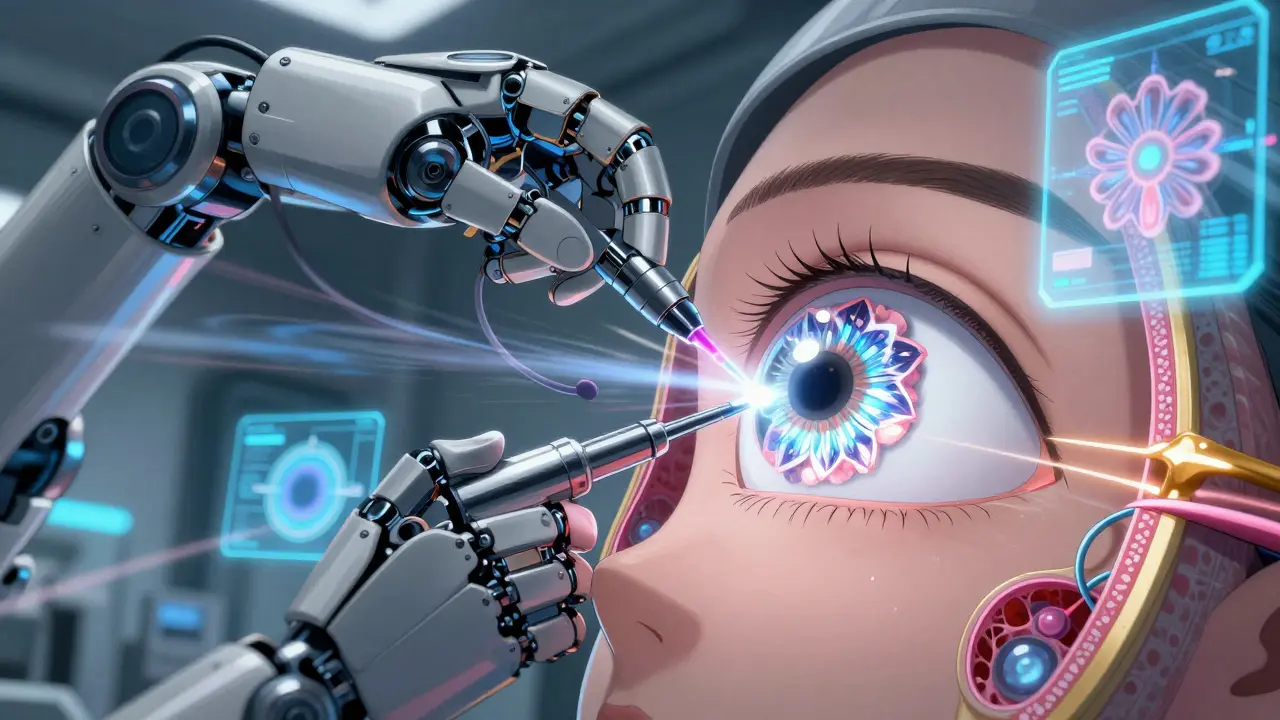
The most common technique is called phacoemulsification. A tiny incision - just 2.2 to 2.8 millimeters - is made in the cornea. An ultrasonic probe breaks the cloudy lens into small pieces and suctions them out. Then, a foldable intraocular lens (IOL) is inserted. It unfolds inside the lens capsule, where your natural lens used to be. The whole thing takes about 15 to 20 minutes. Most people go home the same day, with local numbing drops and no stitches.
What Kind of Lens Will You Get?
Not all IOLs are the same. The most common type is a monofocal lens, which corrects vision for one distance - usually far. You’ll likely still need reading glasses after surgery. These cost between $1,500 and $3,000 per eye, and Medicare typically covers the basic version.
If you want to reduce your dependence on glasses, there are premium options. Toric IOLs correct astigmatism. Multifocal and trifocal IOLs like Alcon’s PanOptix or Johnson & Johnson’s Tecnis Symfony let you see clearly at multiple distances. These can cost $2,500 to $4,500 per eye out-of-pocket. Clinical trials show 81% to 89% of patients with these lenses don’t need glasses for daily tasks. But they’re not perfect - some people report glare or halos at night.
What’s Recovery Really Like?
Don’t expect perfect vision the next day. It’s normal to feel scratchy, itchy, or slightly uncomfortable for a few days. Your vision will be blurry at first. Most people notice improvement within 1 to 3 days, but full recovery takes time. Cleveland Clinic says four weeks. MyHealth Alberta says 3 to 10 weeks. West Boca Eye Center says 6 to 8 weeks. Why the range? Because healing isn’t just about the eye - it’s about your brain relearning how to see.
You’ll need to use eye drops for weeks: antibiotics to prevent infection and steroids to reduce swelling. You can’t get water in your eye, lift heavy things, or rub your eye. Driving is off-limits until your doctor clears you - usually after your first follow-up visit.
Some people feel strange about depth perception after surgery. One Reddit user said, “My brain had to relearn how to judge distance.” That’s because your eyes are now seeing with a new lens - one that doesn’t change focus like your natural lens did. Your brain adapts, but it takes time.
Can You Still Need Glasses After Surgery?
Yes. Even with the best IOLs, some people still need glasses - especially for fine print or computer work. Monofocal lenses fix distance vision, so reading glasses are almost always needed. Even with multifocal lenses, not everyone achieves perfect vision at all distances. A 2022 study in the Journal of Cataract & Refractive Surgery found that 90% of patients regained excellent vision, but outcomes vary based on pre-existing conditions like diabetes or glaucoma. If your eye has other issues, surgery can help, but it won’t fix everything.
What Are the Risks?
Cataract surgery is extremely safe - 99.5% success rate across over a million procedures, according to a 2022 meta-analysis in the British Journal of Ophthalmology. But no surgery is risk-free. About 2% to 5% of patients experience complications. The most common is posterior capsule opacification (PCO), sometimes called a “secondary cataract.” This happens when the membrane holding the new lens becomes cloudy. It’s not a new cataract - it’s scar tissue. It’s easily fixed with a quick, painless laser procedure called YAG capsulotomy, which takes less than five minutes.
Other rare risks include infection, bleeding, or retinal detachment. These happen in less than 1% of cases. Most complications are treatable if caught early.

What’s New in Cataract Surgery?
The field is advancing fast. In January 2023, the FDA approved Zeiss’s AT LISA tri 839MP IOL, designed to improve intermediate vision - perfect for computer screens and tablets. Newer IOLs in clinical trials aim to mimic the natural lens’s ability to shift focus, called accommodating IOLs. These could one day eliminate the need for glasses entirely. The global market for cataract devices is expected to hit $6.32 billion by 2027, driven by aging populations and better technology.
When Should You Consider Surgery?
You don’t need surgery just because you have a cataract. You need it when it interferes with your life. If you can’t drive safely at night, can’t read the news, or avoid social events because you can’t see faces clearly - that’s the time to talk to your eye doctor. There’s no benefit to waiting until you’re “blind.” Modern surgery is safest when performed before the cataract becomes too dense. Delaying can make the procedure harder and recovery slower.
Is Vision Therapy Helpful After Surgery?
Yes - and it’s often overlooked. Some patients struggle to adapt to their new IOL, especially multifocal ones. Vision therapy, offered by specialists like Vision Therapy Austin, uses targeted exercises to help your eyes and brain work together again. Simple tasks like shifting focus between a book and a wall clock can improve eye coordination. Patients report less eye strain, better concentration, and improved visual memory. It’s not for everyone, but if you’re still having trouble after healing, it’s worth asking your doctor.
Final Thoughts: It’s Not Just About Seeing Better - It’s About Living Better
Cataract surgery isn’t just a medical procedure. It’s a return to independence. It’s reading bedtime stories to grandchildren, driving to the grocery store without fear, watching your favorite show without squinting. The data is clear: 98% of patients report high satisfaction. 95% see major improvement. And for most, the results last a lifetime.
If you’re noticing changes in your vision, don’t assume it’s just getting older. Get checked. If cataracts are the cause, you’re not stuck with blurry vision. There’s a safe, proven solution waiting - and it’s more effective today than ever before.
Lana Kabulova
January 22, 2026 AT 16:20arun mehta
January 22, 2026 AT 21:44Chiraghuddin Qureshi
January 24, 2026 AT 21:30Tatiana Bandurina
January 25, 2026 AT 18:42Philip House
January 27, 2026 AT 03:18Akriti Jain
January 27, 2026 AT 17:16Mike P
January 27, 2026 AT 22:00Jasmine Bryant
January 29, 2026 AT 21:17Liberty C
January 31, 2026 AT 18:56shivani acharya
February 2, 2026 AT 05:12Sarvesh CK
February 3, 2026 AT 13:42Hilary Miller
February 3, 2026 AT 16:00